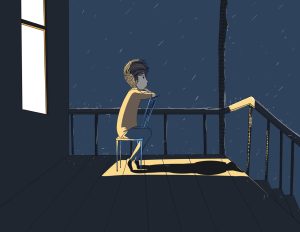

We don’t fall out of love overnight. Emotional distance in relationships rarely begins with a dramatic rupture. More often, it builds slowly, through moments of silence, unmet bids for connection, and misread intentions. One partner may begin to feel invisible. The other may feel criticized no matter what they do. Both may begin to feel like something essential is missing, but neither knows how to talk about it. What used to be closeness becomes conflict or coldness. Emotional safety begins to erode.
In attachment-based couples therapy, these patterns are understood not as incompatibility or communication failure, but as signals of deeper emotional needs going unmet. When partners feel disconnected, they often stop expressing those needs directly. Instead, the hurt shows up as frustration, avoidance, or resentment.
This emotional distance echoes themes in the myth of Eros and Psyche. In the story, Psyche is forbidden to look at her lover, and when she does, fueled by longing and fear, Eros vanishes. Their separation isn’t caused by a lack of love, but by a lack of emotional safety. The myth reminds us that trust and vulnerability are essential to intimacy, and that when fear replaces openness, even the most loving connection can dissolve. Much like in modern relationships, reconnection requires not just love, but repair, understanding, and the willingness to risk being seen.
Emotional Distance in Relationships Begins Quietly
Couples often come to therapy unsure of how they became so distant. “We never used to fight,” they might say, “but now we barely talk.” This quiet disconnection is often more difficult to identify than overt conflict, but just as painful. In emotionally focused therapy (EFT), we understand that emotional distance in relationships begins when partners no longer feel emotionally accessible or responsive to each other.
This disconnection can stem from everyday misattunements, one partner turns toward the other and doesn’t feel met. One asks for comfort and gets advice instead. One shuts down, hoping the other will notice, but nothing happens. Over time, both partners begin to protect themselves. Instead of turning toward each other, they turn inward, or away.
How Unspoken Needs Turn into Resentment
Resentment doesn’t come from thin air. It usually develops in long-term relationships when important emotional needs are continually missed, dismissed, or never voiced at all. Often, individuals aren’t even fully aware of what they’re needing; they just know they feel lonely, frustrated, or unseen. They may tell themselves they’re being too sensitive, too demanding, or that they “shouldn’t need so much.” So they stay quiet. They cope. And the need doesn’t disappear, it calcifies into resentment.
In therapy, this is where we start: not with blame, but with understanding the attachment system. We ask what deeper need is going unspoken. Maybe it’s the need to feel chosen. To feel emotionally safe. To feel valued without having to earn it. When those needs remain unacknowledged, partners start to tell themselves painful stories: “They don’t care,” or “Nothing I do is enough.” Resentment follows, not because the partner is the enemy, but because the longing was never met.
Attachment Patterns Behind Emotional Distance in Relationships
One of the most common dynamics in emotionally distressed couples is one partner protesting while the other withdraws. One partner escalates, raising concerns, asking questions, expressing dissatisfaction, while the other shuts down, gets quiet, or avoids. The protester is often seen as “too much”; the withdrawer is seen as “emotionally unavailable.” But underneath both roles is fear: the fear of being alone, not good enough, rejected, or overwhelmed.
This cycle keeps both partners locked in a loop. The more one pushes, the more the other pulls away. And the more the other pulls away, the more the first partner protests. In EFT, we don’t label these roles as faults, we look at them as adaptive strategies in the face of disconnection. By helping partners recognize this pattern, we open the door to changing it.
Healing Through Attachment-Based Couples Therapy
Attachment-based couples therapy teaches skills and creates safety. In EFT, the goal is to help each partner access and express their core emotional needs in a way that their partner can actually hear. Instead of saying “You never listen to me,” a partner might learn to say, “When I feel like you’re distant, I start to wonder if I still matter to you. That’s when I get upset.”
The therapy process involves slowing things down, helping each person understand their emotional triggers, and creating moments of emotional responsiveness between partners. These moments, called “bonding events,” are powerful in restoring connection. They allow partners to take emotional risks, sharing vulnerability, expressing care, and reaching across the distance.
Reconnecting Starts with Understanding the Distance
Emotional distance in relationships doesn’t always mean it’s over. More often, it means that something essential has gone unheard, a need that was never named, a fear that was never soothed, a longing that was tucked away to keep the peace. Resentment isn’t proof of failure; it’s often the signal that something still matters deeply.
In the myth of Eros and Psyche, their bond breaks not because love disappears, but because fear disrupts trust. Psyche’s longing to see Eros isn’t wrong, but it’s unspoken, secretive, and driven by anxiety. That moment of disconnection becomes the turning point. And yet, the rest of her story is a journey of repair. She labors, grieves, grows, and eventually, connection is restored through understanding, not perfection.
The same is true for couples in therapy. Emotional reconnection isn’t about getting everything right. It’s about creating a space where needs can be spoken, fears can be named, and trust can be rebuilt one moment at a time.
At Luceris, we help couples move from silent distance to active repair, by helping you find the words for what was always there beneath the surface.
Book a session or contact us when you’re ready to begin.