

Many of us look up how to deal with anger right after it has cost us something: a partner’s hurt look, or a work meeting that turned ugly. Anger is a signal that something feels unfair, threatening or blocked. The damage comes from how we act on it.
Right now, start with a pause. Breathe in for a count of four and out for six. Let your shoulders drop and unclench your hands.
Once the moment passes, it helps to understand where your anger comes from. Homer’s Iliad, a poem nearly 3,000 years old, opens with the rage of Achilles. His anger nearly cost the Greeks the Trojan War, and it cost him the friend he loved most.
Why anger is a normal emotion
Anger is one of the most ordinary emotions we have. We feel it when someone crosses a line we care about, or when a need of ours goes unmet.
Feelings give us information, and the trouble usually starts with what we do next. Anger becomes a problem when it shows up too often or too strongly, or when it comes out as threats or aggression. If that keeps happening, individual therapy can help you work out what’s driving it.
Anger helps us most when we use it to find what we care about, then decide calmly what to do. There’s more on this in why it helps to embrace negative emotions.
Agamemnon, the king leading the Greeks at Troy, takes the captive woman Briseis from Achilles, his best warrior, in front of the whole army. Achilles has every reason to feel angry. Then he acts on that anger without pausing.
He walks out of the war, and the Greeks start losing. His closest friend, Patroclus, puts on Achilles’ armour and leads the fight in his place, and the Trojan prince Hector kills him. Later in the poem, Achilles feels the grief and guilt beneath his rage.
Early warning signs of anger
It helps to catch anger early. Most of us notice it in the body first, often before we realize we’re angry:
- A faster heartbeat or a tight chest
- Heat in the face or neck
- Tension in the jaw, shoulders or hands
- Clenched fists or a rising voice
Then anger shows up in our thoughts:
- “They always do this.”
- “They did that on purpose.”
- “This is so unfair.”
- Replaying what we should have said
Once you notice anger building, rate it from 1 to 10, where 1 means calm and 10 means losing control. Aim to act around a 4 or 5, while you can still think clearly. By an 8, the skills below get much harder to use.
Achilles’ first warning sign is his own hand reaching for his sword. He wants to cut Agamemnon down for the insult, and the goddess Athena grabs him by the hair to stop him. For the rest of us, the 1-to-10 check is our chance to stop early.
How to control anger in the moment
When anger spikes, calm the body first. Slow breathing and other calming activities reduce anger and aggression, while activities that raise arousal, such as hitting a bag or jogging, mostly fail to help (Kjærvik & Bushman, 2024). Jogging was the activity most likely to make anger worse.
Try these steps for how to calm down when angry:
- Take a time-out, with a plan to come back. Say something like, “I need 20 minutes, then I want to finish this.” A walk around the block helps. Skip the alcohol, and wait to drive until you’ve cooled down.
- Breathe slowly. Breathe in for a count of four and out for six. Making the out-breath longer helps your body settle.
- Drop your shoulders and open your hands. Check your jaw, too. Relaxation works best when we practise it on calm days, so the skill is ready when we need it.
- Splash cold water on your face. This sets off the dive reflex, which slows the heart. Dialectical behaviour therapy teaches it as a quick reset, though researchers haven’t tested it for anger itself. Check with your doctor first if you have a heart condition or an eating disorder, or if you take medication that slows your heart rate.
- Repeat a calm phrase with each out-breath, such as “Slow down” or “I can handle this later.” Therapists call this cue-controlled relaxation.
- Hold off on that text or call. Write it if you need to, save it as a draft and reread it once you’re calm.
Achilles uses two kinds of time-out in the Iliad. The first is a walkout meant to make the Greeks suffer. He has no plan to return, and the walkout costs Patroclus his life.
Near the end, Hector’s father, Priam, comes to ransom his son’s body. Achilles orders his servants to wash the body where Priam can’t see it, because he knows the old man’s grief could set off his own rage. Knowing our triggers and planning around them is a skill we can practise.
How our thoughts make anger stronger
Anger depends a great deal on how we read a situation. Psychologists call these quick, often automatic judgments appraisals. Blaming another person is the one most closely tied to anger (Kuppens et al., 2003). A few common ones:
- “They did this on purpose.”
- “They could have prevented this.”
- “This should not happen.”
- “I can’t handle this.”
Achilles has several of these thoughts at once. He believes Agamemnon could have taken compensation from anyone and chose him on purpose.
Say a co-worker snaps at us in a meeting, and later we learn their child went to the hospital that morning. Our anger drops, because our reading of their behaviour has changed.
We can practise that shift on purpose. When anger rises, try trading the first thought for a more flexible one:
- “They did this on purpose” can become “I don’t know their reasons yet.”
- “It’s all their fault” can become “Several things led here, and my response belongs to me.”
- “This should not happen” can become “I wish this were different, and I can cope with it.”
- “I can’t handle this” can become “This is hard, and I’ve handled hard things before.”
A new thought only helps when we believe it.
How to express anger in a healthy way
Bottling anger up and exploding both cause problems. Anger we keep inside tends to leak out later as irritability or low mood. Exploding feels like release, and it leaves us angrier afterward. What helps is saying what’s wrong, calmly and clearly.
- Wait until you’re calm, so you can choose words that say what you mean.
- Use “I” statements, and leave room for their side. For example: “I felt brushed off when the plan changed and nobody told me. I know your day was packed. Can we figure out how to check in next time?”
- Be specific, and name the one thing that happened. “You never listen” usually starts a fight. Try something concrete, such as “You were on your phone while I told you about my mom.”
- Listen. Let the other person finish, then ask what was going on for them.
- Look for a solution together. Agree on what happens next time, and let the question of blame go.
After Hector dies, King Priam comes to Achilles unarmed. He tells Achilles what he has lost and asks him to think of his own father. Priam’s honesty moves Achilles to pity, and the two enemies end up weeping together.
Anger management tips for everyday life
Our daily habits affect how quickly we get angry. These habits make anger easier to manage:
- Sleep enough. People who cut their sleep by a few hours for two nights reported more anger than people who slept normally (Krizan & Hisler, 2019).
- Move regularly. Physical activity eases low mood and anxiety, and both can leave us quicker to anger.
- Drink less. Alcohol makes aggression more likely, so it’s a poor choice when we’re already angry.
- Manage your stress. Notice when stress peaks in your day, and add breaks to the hardest parts.
- Stop replaying it. Stewing over an insult keeps anger alive. In lab studies, it made people more likely to lash out at someone else, even after an eight-hour wait (Bushman et al., 2005). When you catch yourself rehearsing the argument, turn your attention to something else.
- Use humour with care. Gentle, shared humour can ease tension. Sarcasm stings, so leave it out.
- Keep a short anger log. Write down the trigger, your thoughts, your body’s signals and your 1-to-10 rating. Note whether you were hungry or tired. Within a few weeks, a pattern usually becomes clear.
For more skills like these, see our guide to emotional regulation techniques.
After Patroclus dies, Achilles refuses food until Hector is dead. Even after his revenge, he can’t sleep, and for days he drags Hector’s body around his friend’s tomb. Exhaustion and replaying his loss keep his anger going.
What lies underneath our anger
Anger often covers a softer feeling that is harder to face, or one we never learned to handle.
Many therapists describe anger with the image of an iceberg. Anger is the part above the water that everyone sees. Below the waterline there’s usually more: hurt, fear, shame, exhaustion or the sense of not being heard. Anger can feel safer than those feelings, because it makes us feel strong.
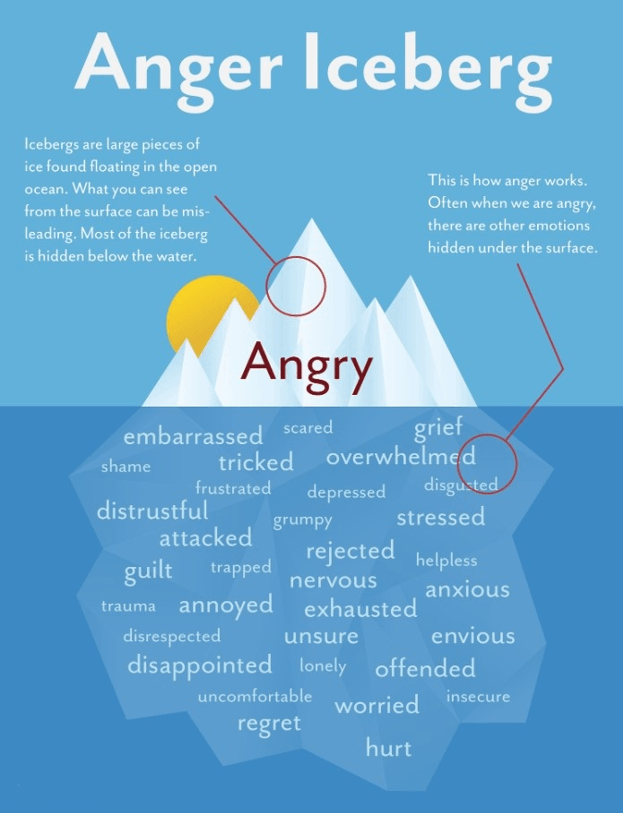
Past hurts can make a present moment feel much bigger, and part of the anger then belongs to the older hurt. In relationships, frustrations that go unsaid tend to pile up until something small sets off something big. If that sounds familiar, our piece on resenting your partner goes deeper.
Naming the feeling clearly helps. In one brain-imaging study, putting a name to the emotion on a face lowered activity in the amygdala, the brain’s threat detector (Lieberman et al., 2007). The more precisely we can name what we feel, the more choice we have in how we respond.
Humiliation lies beneath Achilles’ first anger, since his king shamed him in front of the army. Grief and guilt lie beneath his second, because he let his friend fight in his place.
Killing Hector leaves that grief as strong as before. Then Priam arrives, and the two men weep together, Priam for his son and Achilles for his father and his friend. That night, Achilles eats and sleeps.
When to talk to a therapist about anger
Consider getting support if:
- Anger is damaging your relationships or your work
- You often regret what you said or did
- People around you seem afraid of you
- You break things or get physical
If these happen often, you need more tools than you have right now. In therapy, you can learn how to manage anger and work on its causes. At Luceris, we offer individual therapy for anger and impulsive patterns online or by phone across Canada.
Frequently asked questions
Why am I getting angry so easily lately?
If you’re getting angry more easily than usual, something has usually shortened your fuse. Poor sleep, ongoing stress, hunger and pain all make intense anger more likely. Irritability also often comes with depression or anxiety, and some medical issues, such as an overactive thyroid, can show up the same way. If the change is new or isn’t lifting, check in with your doctor and consider talking to a therapist.
How do I deal with anger issues in a relationship?
To deal with anger issues in a relationship, start by slowing conflicts down. Agree on time-outs in advance and take one issue at a time, then say what’s underneath the anger. If anger includes threats or hitting, or a partner feels afraid, the person using violence needs individual help before couples therapy. Women in Ontario experiencing abuse can call the Assaulted Women’s Helpline at 1-866-863-0511, or 911 in an emergency.
Does hitting a pillow or yelling help release anger?
Hitting a pillow or yelling keeps anger going. In a classic study, people who hit a punching bag while thinking about someone who had insulted them ended up angrier and more aggressive than people who sat quietly for two minutes (Bushman, 2002). Calming the body helps more.
Do anger management classes work?
Anger management classes work for many people. Reviews of the research find that anger treatments, most often cognitive behavioural therapy, bring at least moderate improvement, though results for aggressive behaviour are less consistent (Lee & DiGiuseppe, 2018). Classes teach anger management skills, and individual therapy adds room to work on what lies underneath.
Learn how to control your anger
Frequent anger usually means something important to you needs attention. If you’d like help understanding what your anger is about, book a free 15-minute consultation with Luceris. We’ll talk through what’s going on and whether working together feels like the right fit.
Sources
Bushman, B. J. (2002). Does venting anger feed or extinguish the flame? Personality and Social Psychology Bulletin, 28(6).
Bushman, B. J., Bonacci, A. M., Pedersen, W. C., Vasquez, E. A., & Miller, N. (2005). Chewing on it can chew you up. Journal of Personality and Social Psychology, 88(6).
Kjærvik, S. L., & Bushman, B. J. (2024). A meta-analytic review of anger management activities that increase or decrease arousal: What fuels or douses rage? Clinical Psychology Review, 109, 102414.
Krizan, Z., & Hisler, G. (2019). Sleepy anger: Restricted sleep amplifies angry feelings. Journal of Experimental Psychology: General, 148(7).
Kuppens, P., Van Mechelen, I., Smits, D. J. M., & De Boeck, P. (2003). The appraisal basis of anger: Specificity, necessity, and sufficiency of components. Emotion, 3(3), 254–269.
Lee, A. H., & DiGiuseppe, R. (2018). Anger and aggression treatments: A review of meta-analyses. Current Opinion in Psychology, 19.
Lieberman, M. D., Eisenberger, N. I., Crockett, M. J., Tom, S. M., Pfeifer, J. H., & Way, B. M. (2007). Putting feelings into words: Affect labeling disrupts amygdala activity in response to affective stimuli. Psychological Science, 18(5), 421–428.
National Institute of Mental Health. (2024). Depression. U.S. Department of Health and Human Services.
Paradis, C., Butt, P., Shield, K., Poole, N., Wells, S., Naimi, T., Sherk, A., & the Low-Risk Alcohol Drinking Guidelines Scientific Expert Panels. (2023). Canada’s guidance on alcohol and health: Final report. Canadian Centre on Substance Use and Addiction.