

Feeling emotionally overwhelmed means your feelings are coming in faster or stronger than you can handle right now. Most of us think “I am overwhelmed” after weeks of stress and responsibility piling up. It happens to almost everyone, and it comes from a nervous system that evolved to protect us. For quick relief, start with the body by breathing out slowly, then pick one small next step from the list below.
What does it mean to be emotionally overwhelmed?
Being emotionally overwhelmed means we’re dealing with more stress and emotion than we can usually cope with. Talking ourselves down or pushing through stops working for a while. The reaction starts in old parts of the brain, where all mammals share emotional systems for fear, rage, grief and care (Panksepp, 2011).
Overwhelm can also feel out of proportion to whatever set it off. We cry over a spilled coffee or a short email and wonder where the tears came from. Often we’re reacting to weeks of built-up stress, and the coffee is only the last of it (McEwen, 1998).
In a group of chimpanzees, tension can spread quickly. One chimp stiffens or bares its teeth, and soon the whole troop is on alert. We carry the same old emotional wiring, and we can react to a late-night email much as a chimp reacts to a rival. That’s one reason we react so strongly to something small, and why calming down starts with the body.
Signs you’re emotionally overwhelmed
Most of us notice a mix of these signs, and the earlier you spot them, the more time you have to calm down.
In your feelings
- Irritable over small things
- Tearful, sometimes without knowing why
- Panicky, with a sense that something bad is about to happen
- Numb or flat
- On edge and easy to startle
In your body
- A tight chest or shallow breathing
- A racing or pounding heart
- Headaches or a clenched jaw
- Tiredness that lasts all day
- Poor sleep, such as lying awake or waking too early
If chest pain or heart symptoms are new, see a doctor to rule out a medical cause.
In what you do
- Snapping at the people closest to you
- Shutting down or going quiet
- Avoiding tasks and messages
- Freezing, with no idea where to start
- Struggling to decide anything, even what to eat
What causes emotional overwhelm
Often several of these causes overlap.
- Stress piling up over weeks or months, with little time to recover
- Big life changes, such as a move, a breakup, a new baby or a job loss
- Too many roles at once, like parent, partner, employee and caregiver
- Poor sleep or exhaustion, which leave the brain’s alarm centre more reactive (Yoo et al., 2007)
- Years of pushing feelings down, a habit linked to lower well-being (Gross & John, 2003)
- Past difficult experiences, especially trauma, after which reminders can set off strong reactions quickly (Corrigan et al., 2011)
- Ongoing anxiety or low mood, which make everyday stress harder to manage
For parents, overwhelm can build around a new baby or a hard stage with an older child, and parenting therapy can help you adjust to the change faster and make the transition less bumpy.
How to calm down when overwhelmed by emotions
Use these steps in the moment itself, in whatever order feels doable.
- Step away if you can. In a quieter room, your body has less to react to.
- Breathe out longer than you breathe in. Take two short breaths in through the nose, then one long breath out. Daily practice of this “cyclic sighing” lifted mood more than mindfulness meditation did (Balban et al., 2023).
- Ground yourself. Rest one hand on your chest and one on your belly for 20 seconds, or name five things you can see. Self-soothing touch like this lowered the stress hormone cortisol (Dreisoerner et al., 2021).
- Name the feeling plainly, such as “this is panic” or “I feel trapped.” Putting a feeling into words lowered activity in the brain’s alarm centre (Lieberman et al., 2007).
- Use cold water or movement. Splash cold water on your face, or walk briskly for a few minutes. Cold water on the face slows the heart through the body’s main calming nerve (Kinoshita et al., 2006). Check with a doctor first if you have a heart condition or an eating disorder, or take heart-rate medication.
- Pick one small next step, such as answering one email or drinking a glass of water. Leave the rest of the list for later.
These steps are first aid for the moment. Our guide to emotional regulation techniques covers the full toolkit.
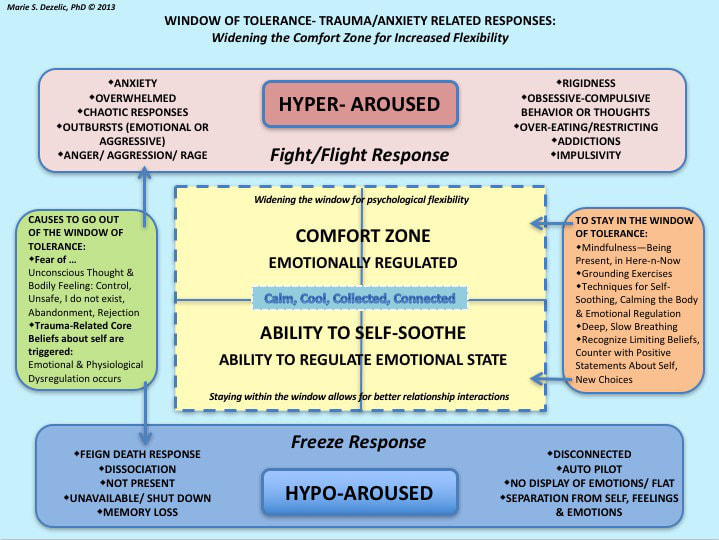
The window of tolerance is a model therapists use to show how much stress our nervous system can handle (Corrigan et al., 2011). Inside the window, we can feel strong emotions and still think clearly. Above it is hyperarousal, the fight-or-flight zone of panic and racing thoughts. Below it is hypoarousal, the freeze zone of numbness and shutting down. Above the window, the long exhale in step 2 suits you best. Below it, try movement and posture, such as lifting your head or feeling your feet on the floor (Fisher, 2011).
How to stop overwhelm from piling up
Most of the prevention work happens in ordinary weeks, before stress peaks.
- Learn your early warning signs, such as a clenched jaw or snapping at small things. Write them down so you can catch them sooner.
- Protect sleep and regular meals, even during busy weeks. Put sleep first, since tiredness makes the brain’s alarm centre more reactive.
- Say no to one thing this week. Pick a favour or commitment you can drop or delay.
- Write tomorrow’s tasks down before bed. People who wrote a specific to-do list at bedtime fell asleep faster (Scullin et al., 2018).
- Make room for sadness or anger when it shows up, and let it run its course for a few minutes. People who tend to accept their feelings report better mental health (Ford et al., 2018). We go further in our article on embracing negative emotions.
- Talk to someone. Tell a friend or family member what the week has been like, out loud. When you say it out loud, you use the same naming skill as in step 4.
In many old tales, a dragon guards treasure at the edge of a dark forest. The hero faces it more than once and learns its habits with each visit. Making room for a hard feeling follows the same pattern: a few minutes at a time, coming back to it again and again. In cognitive behavioural therapy (CBT), therapist and client build up the same way. Someone afraid of speaking up might practise with a friend first, then in a small meeting, and take on larger groups once those steps feel manageable.
Sometimes the overwhelm comes from upsetting, unwanted thoughts that pop up and return again and again. For those, see our guide to unwanted thoughts that keep coming back.
When to talk to a therapist
Consider speaking with a therapist if any of these sound familiar:
- You feel overwhelmed most days, for weeks at a time.
- It affects your work, sleep, health or relationships.
- You have panic attacks.
- You use alcohol or other substances to get through the day.
- The overwhelm comes with low mood or a sense of hopelessness.
In therapy, clients practise noticing fear as it rises and staying with it until the body steadies. The aim is to show, through experience, that a strong feeling can rise and then pass.
Luceris is a virtual clinic offering individual therapy for anxiety and overwhelm to clients across Canada. Some people also work with their doctor on medication.
Call or text the Suicide Crisis Helpline at 9-8-8 if you are in crisis or thinking about suicide. If you or someone else is in immediate danger, call 911.
Frequently asked questions
What is chronic overwhelm?
Chronic overwhelm means feeling emotionally overwhelmed most days for weeks or months. It happens when new stress keeps piling up before you’ve recovered from the last round. The long-term wear and tear from this pattern is called allostatic load (McEwen, 1998). At that stage, it helps to plan recovery time as carefully as you practise coping skills.
Why do I feel everything so strongly?
You may feel everything so strongly because your nervous system is more sensitive to what happens around you. In one study, about 31% of adults scored as highly sensitive (Lionetti et al., 2018). Sleep loss and ongoing stress can also make feelings stronger for a while. High sensitivity is a common trait, and one-on-one counselling can help when it gets in the way of daily life.
What should I do when I feel overwhelmed and depressed?
When you feel overwhelmed and depressed, tell someone you trust and book time with a doctor or therapist. When your mood is low, calming techniques are harder to use, so outside support matters more. If you feel hopeless or think about suicide, call or text 9-8-8 right away.
What can I do when the world feels heavy?
When the world feels heavy, limit your news intake and put your energy into something nearby that you can change. In one study, following coverage of the Boston Marathon bombing for six or more hours a day was linked to more acute stress than being there (Holman et al., 2014). When you help a neighbour or a local cause, you have something to do with the worry.
Book a free consultation
If overwhelm keeps coming back, book a free 15-minute consultation with Luceris. We can talk through what you’re facing and whether individual therapy fits.
Sources
Balban, M. Y., Neri, E., Kogon, M. M., Weed, L., Nouriani, B., Jo, B., Holl, G., Zeitzer, J. M., Spiegel, D., & Huberman, A. D. (2023). Brief structured respiration practices enhance mood and reduce physiological arousal. Cell Reports Medicine, 4(1), Article 100895.
Corrigan, F. M., Fisher, J. J., & Nutt, D. J. (2011). Autonomic dysregulation and the window of tolerance model of the effects of complex emotional trauma. Journal of Psychopharmacology, 25(1), 17–25.
Dreisoerner, A., Junker, N. M., Schlotz, W., Heimrich, J., Bloemeke, S., Ditzen, B., & van Dick, R. (2021). Self-soothing touch and being hugged reduce cortisol responses to stress: A randomized controlled trial on stress, physical touch, and social identity. Comprehensive Psychoneuroendocrinology, 8, Article 100091.
Fisher, J. (2011). Sensorimotor approaches to trauma treatment. Advances in Psychiatric Treatment, 17(3), 171–177.
Ford, B. Q., Lam, P., John, O. P., & Mauss, I. B. (2018). The psychological health benefits of accepting negative emotions and thoughts: Laboratory, diary, and longitudinal evidence. Journal of Personality and Social Psychology, 115(6), 1075–1092.
Gross, J. J., & John, O. P. (2003). Individual differences in two emotion regulation processes: Implications for affect, relationships, and well-being. Journal of Personality and Social Psychology, 85(2), 348–362.
Holman, E. A., Garfin, D. R., & Silver, R. C. (2014). Media’s role in broadcasting acute stress following the Boston Marathon bombings. Proceedings of the National Academy of Sciences, 111(1), 93–98.
Kinoshita, T., Nagata, S., Baba, R., Kohmoto, T., & Iwagaki, S. (2006). Cold-water face immersion per se elicits cardiac parasympathetic activity. Circulation Journal, 70(6), 773–776.
Lieberman, M. D., Eisenberger, N. I., Crockett, M. J., Tom, S. M., Pfeifer, J. H., & Way, B. M. (2007). Putting feelings into words: Affect labeling disrupts amygdala activity in response to affective stimuli. Psychological Science, 18(5), 421–428.
Lionetti, F., Aron, A., Aron, E. N., Burns, G. L., Jagiellowicz, J., & Pluess, M. (2018). Dandelions, tulips and orchids: Evidence for the existence of low-sensitive, medium-sensitive and high-sensitive individuals. Translational Psychiatry, 8(1), Article 24.
McEwen, B. S. (1998). Protective and damaging effects of stress mediators. New England Journal of Medicine, 338(3), 171–179.
Panksepp, J. (2011). The basic emotional circuits of mammalian brains: Do animals have affective lives? Neuroscience & Biobehavioral Reviews, 35(9), 1791–1804.
Scullin, M. K., Krueger, M. L., Ballard, H. K., Pruett, N., & Bliwise, D. L. (2018). The effects of bedtime writing on difficulty falling asleep: A polysomnographic study comparing to-do lists and completed activity lists. Journal of Experimental Psychology: General, 147(1), 139–146.
Yoo, S.-S., Gujar, N., Hu, P., Jolesz, F. A., & Walker, M. P. (2007). The human emotional brain without sleep: A prefrontal amygdala disconnect. Current Biology, 17(20), R877–R878.