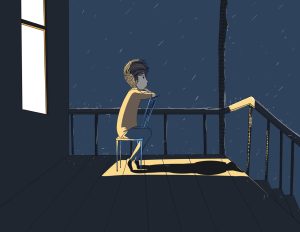

We all carry an underworld inside us. We store grief, shame, and old wounds in that dark place. Learning how to practice acceptance starts with visiting that underworld without hiding from it. Nietzsche compared his own philosophy to the descent of Odysseus, who traveled into the underworld to gain knowledge from the dead. In Human, All Too Human, Nietzsche wrote:
“I too have been in the underworld, just as Odysseus, and I shall often be there again. Not even my own blood have I spared.”
We can borrow this image for our own healing. Learning how to practice acceptance means we visit the depths, and then we choose to come home, again and again, for as long as living requires it.
This blog will focus on we descending and resurfacing in life, where we finally climb toward something higher. Along the way, we will pair Nietzsche’s mythic language and reflections on Odysseus with modern research on acceptance, avoidance, and psychological flexibility. Both traditions, ancient philosophy and clinical science, arrive at a similar conclusion. We heal not by fleeing pain, but by facing it directly.
Radical Acceptance and the Descent Underground
We often treat pain like something to outrun. We distract ourselves, numb ourselves, or pretend the wound never happened. Nietzsche imagined the opposite approach. In the preface to Daybreak, he described a mole “at work digging, mining, undermining,” someone who moves slowly through the dark toward buried truths. He wrote that we can see this figure clearly, “provided that you have eyes for such deep work,” moving cautiously but surely through the dirt.
This digging was not comfortable work for Nietzsche, either. In that same Daybreak preface, he confessed a personal cost:
“One easily unlearns how to hold one’s tongue when one has for so long been a mole and all alone like me.”
Solitude, in his account, becomes part of the labor. We rarely choose isolation during our hardest seasons, yet many of us feel it anyway, tucked away with private griefs nobody else can fully witness.
Avoidance, meanwhile, rarely heals anything. Research on experiential avoidance shows that resisting or suppressing painful internal experiences tends to increase distress rather than resolve it, functioning as a transdiagnostic vulnerability across many conditions. Suppressing emotion in particular carries a steep cost. Classic studies found that suppressing emotional expression increases physiological arousal without actually reducing the felt intensity of the emotion. We cannot out-argue grief, nor can we out-plan heartbreak. Sometimes the only way through sits directly underground.
Nietzsche also warned of a real danger in staying underground too long. In Beyond Good and Evil, he wrote one of his most famous lines:
“He who fights with monsters should be careful lest he thereby become a monster. And if you gaze long into an abyss, the abyss will also gaze into you.”
We can honor this warning without abandoning the descent altogether. We visit our depths; we do not move in permanently.
How to Practice Acceptance: Radical Acceptance as Distress Tolerance
Dialectical behavior therapy names this descent directly. Marsha Linehan developed radical acceptance as a distress tolerance skill for moments when a painful situation cannot immediately change. The core formula holds that pain plus nonacceptance equals suffering. Pain alone often cannot be avoided; the added layer of fighting it, however, remains within our influence.
This formulation echoes something Nietzsche also believed. Sickness, decadence, and suffering were not, for him, problems to argue away. In Twilight of the Idols, Nietzsche examined history’s wisest figures and their shared verdict on life. He quoted their consensus with some suspicion:
“In all ages, the wisest have always agreed in their judgment of life: it is no good. Is it possible that they were every one of them a little shaky on their legs?”
Even in questioning their pessimism, Nietzsche refused to deny the pain underneath it. He simply asked us to examine it more closely rather than accept it uncritically.
Nietzsche practiced what he preached about proximity to suffering. In Ecce Homo, his autobiography, he listed his many health struggles and then remarked:
“Having admitted all this, do I need to say that I am experienced in questions of decadence? I know them inside and out.”
He did not claim invulnerability. He claimed familiarity, earned the hard way, through repeated visits to his own underworld.
Odysseus at the Threshold: Visiting the Underworld Without Living There
Odysseus never actually enters the underworld in Homer’s Odyssey. He stands at its entrance, pours a libation, sacrifices two sheep, and summons the dead forward to speak with him. He listens to Tiresias, his mother, and his fallen comrades. Then, crucially, he sails away. This detail matters enormously for radical acceptance. We can visit our pain without setting up permanent residence there.
Achilles offers the most striking moment of this visit. Odysseus tells him that his glory endures even in death, since the Greeks now regard him as a god among the shades. Achilles answers sharply, refusing the comfort offered him:
“No winning words about death to me, shining Odysseus. By God, I would rather slave on earth for another man, some dirt poor tenant farmer who scrapes to keep alive, than rule down here over all the breathless dead.”
Nietzsche read this passage not as regret but as a fierce, almost desperate love of life. In The Birth of Tragedy, he wrote of the Greeks and their attachment to mortal existence:
“If once the lamentation is heard, it will ring out again, of the short-lived Achilles.. it is not unworthy of the greatest hero to long for a continuation of life, even as a day laborer.”
Far from undermining Achilles’ heroism, Nietzsche argued, this longing revealed how completely the Greeks affirmed even a difficult life over no life at all.
Modern positive psychology has begun testing something remarkably close to this Nietzschean idea directly. Researchers have operationalized amor fati (love of fate), Nietzsche’s concept of joyfully embracing the whole of one’s life, both good and bad, as a measurable psychological construct. Across international samples, higher amor fati predicts greater life satisfaction, personal growth, and purpose in life, and lower depressive symptoms and suicidal ideation. In a related study of emerging adults, amor fati predicted both hedonic and eudaimonic (a state of deep well-being) even after controlling for general positive and negative mood.
Radical acceptance asks something similar of us in daily life. We name what hurts, without minimizing or exaggerating it. We can grieve fully and still choose, like Achilles, to prize even a modest, ordinary life over numbness, avoidance, or despair.
How Odysseus Summoned Achilles
The mechanics of this summoning matter as much as its content. Odysseus does not simply wander into Hades and starts talking. He first digs a pit, performs a careful ritual, and only then does the underworld come to him. He pours libations of honey, wine, and water, sprinkles barley, and sacrifices two sheep, letting their blood pool in the pit he dug. The spirits of the dead gather toward that blood, drawn by it, eager to speak. Nietzsche seized on this detail directly, contrasting his own method with the hero’s. Unlike Odysseus, it was his own sanity sacrificed to gain his underworld wisdom. Where Odysseus offers animal sacrifice at a safe remove, Nietzsche insists his philosophy costs him something closer to himself.
Once the ritual opens the threshold, a whole procession of the dead approaches Odysseus, and he must choose carefully whom to let speak. Tiresias arrives first, offering prophecy about the journey home. Odysseus’s own mother appears next, and he learns of her death and his father’s grief, details he could not have known otherwise. Only after these encounters does Achilles step forward among the shades of fallen warriors. Odysseus greets him with what he intends as comfort and honor, telling Achilles that no man before or after him has been so blessed, since the Greeks now honor him like a god even in death and he rules with authority over the dead.
This is precisely where Achilles refuses the frame Odysseus offers him. Rather than accept the consolation of posthumous glory, Achilles answers with the now-famous rejection. The exchange destabilizes the entire heroic logic that sent Achilles to an early grave in the first place, dying for glory, and it leaves interpreters unsettled centuries later.
That instability is worth sitting inside rather than resolving too quickly. Several readings compete for this single passage, and none of them fully cancels the others out. One reading treats Achilles as genuinely regretful, a warrior who, given the chance, would trade his glorious death for an unremarkable, ongoing life. Another reading hears something more like a later, more mature poetic voice, quietly critiquing the entire heroic code that once demanded glory over survival. A third reading turns the moment inward, toward psychology, treating this underworld scene as an attempt to humanize a nearly superhuman figure. A fourth reading turns toward Odysseus himself, suspecting that the wily hero is telling his own audience, a peace-loving, homebound culture, exactly what it wants to hear: that survival matters more than a blaze of glory, whether or not Odysseus privately believes it.
Nietzsche’s own reading cuts against the simplest interpretation of regret. He does not read Achilles as sorry he died young. He reads Achilles as so thoroughly in love with existence that even its most diminished, laborious form outweighs the grandest death imaginable. The lamentation, in this view, becomes a strange kind of praise. Achilles is not renouncing his choice to die gloriously; he is revealing how completely the Greeks clung to life in any form at all, right down to its most humble, difficult version. Radical acceptance recognizes this same pattern in ordinary grief. We can wish a hard chapter had gone differently and still affirm, without contradiction, that we would choose to keep living through it again.
How to Practice Acceptance: Radical Acceptance Is Not Resignation
Many people confuse acceptance with giving up. Nietzsche’s Odysseus proves the opposite. Odysseus lies, tricks, and maneuvers his way home; he does not passively accept whatever fate hands him. Nietzsche admired this cunning openly. In notes later published as The Will to Power, he argued that deception itself signals a kind of vitality:
“The most supreme cunning belongs to the very essence of the elevation of man.”
For Nietzsche, the capacity to creatively navigate a difficult world, rather than simply submit to it, marked the highest human types.
Acceptance, understood this way, becomes active rather than passive. We stop fighting facts we cannot change, and we redirect that freed energy toward what we actually can influence. This distinction sits at the center of Acceptance and Commitment Therapy, which pairs acceptance of difficult inner experience with committed action toward one’s values. Acceptance clears the runway; it does not ground the plane.
Nietzsche also targeted the moral traditions that ask us to escape reality rather than face it honestly. In Ecce Homo, he compared morality to Circe, the witch from the Odyssey who turned Odysseus’s men into swine after luring them with beautiful singing. He wrote:
“Morality, the Circe of mankind, has falsified everything psychological, root and branch.”
He pressed the metaphor further, asking pointedly:
“What man before my time had descended into the underground caverns from out of which the poisonous fumes of this ideal… burst forth?”
Radical acceptance resists that same falsifying impulse. We stop dressing up pain in comforting lies, and we look at it directly instead. Notably, though, Odysseus himself is never fully captured by Circe either. He wins her over with help from the gods, enjoys a year of feasting on her island, and then moves on toward the underworld and eventually home. He engages fully with pleasure and danger alike, without becoming trapped by either one.
Radical Acceptance Builds the Ground for Change
Meta-analytic research across dozens of clinical trials links acceptance-based approaches to reduced psychological distress across a wide range of conditions, including anxiety, depression, and chronic pain. Workplace studies echo this pattern outside the clinic as well. Employees higher in psychological flexibility and job control report better mental health, greater job satisfaction, and stronger performance than employees who rely on avoidance.
Systematic reviews of workplace acceptance and commitment training programs similarly find measurable improvements across the specific sub-processes of psychological flexibility, including present-moment awareness, acceptance, and committed action. Facing reality directly, in other words, tends to help far more than fleeing it, whether the setting involves grief, illness, or an ordinary Tuesday at work.
The Surface: Coming Back Changed
After the descent, something has to come next. Nietzsche, in the preface of Nietzsche contra Wagner, insisted that we cannot stay underground forever. He described vividly what happens when we return from the depths:
“In this world, on this surface, a man returns as though born again. He has new skin. He is more susceptible, more full of wickedness. He has a finer taste for joyfulness. His senses are more cheerful.”
We do not return from our own hard seasons unchanged, either. Nietzsche noted three qualities in particular within this passage: heightened sensual experience, a renewed capacity for joy and innocence, and a sharper, more playful cunning. He linked all three to the same trait he prized in Odysseus.
Nietzsche believed the pre-Socratic Greeks mastered this return through art and myth rather than denial. Rather than escape into a beyond world, they transformed terror directly into meaning. Thunderstorms became Zeus; the merciless, ship-swallowing sea became Poseidon. He wrote in The Birth of Tragedy:
“Thus do the gods justify the life of man in that they themselves live it. The only satisfactory theodicy.”
Learning how to practice acceptance invites a similar reframing for us today. We do not deny the storm, but find a way to live fully alongside it, and sometimes we even find beauty inside it. This capacity to reframe suffering into meaning appears clinically as well, under the name posttraumatic growth. Survivors of serious illness, bereavement, and disaster frequently report positive transformation across five domains: closer relationships, new life possibilities, personal strength, spiritual change, and a deepened appreciation of life. Crucially, researchers stress that posttraumatic growth is not automatic; it emerges through active cognitive processing of the traumatic event, not through avoidance of it. Nietzsche’s mole, digging patiently underground, was doing exactly this kind of processing, long before clinicians gave it a name.
The Eternal Recurrence: Would We Call It Divine?
Nietzsche pushed life affirmation to its most extreme test through a single thought experiment. In The Gay Science, he imagined a demon slipping into our loneliest moment with a proposal. He wrote it directly:
“What, if some day or night a demon were to steal after you into your loneliest loneliness and say to you: ‘This life as you now live it and have lived it, you will have to live once more and innumerable times more… The eternal hourglass of existence is turned upside down again and again, and you with it, speck of dust!’ Would you not throw yourself down and gnash your teeth and curse the demon who spoke thus? Or have you once experienced a tremendous moment when you would have answered him: ‘You are a god and never have I heard anything more divine!'”
This is the doctrine of eternal recurrence, and it functions as a diagnostic test rather than a literal cosmology. Nietzsche does not ask whether we approve of our best moments alone. He asks whether we could affirm the entire cycle, every joy and every humiliation, every triumph and every private failure, repeating.. without end. Gnashing our teeth at the demon reveals one relationship to life. Calling the demon divine reveals another, far rarer one.
The true difficulty of this test only becomes clear in its hardest cases. It is easy to say we want a moment to last forever while holding a newborn son in our arms. Joy asks nothing of us in that instant; affirmation feels effortless. But can we say the same on the day we learn that same son has died? The demon does not offer us only the newborn’s first cry. He offers the whole sequence, including the funeral, and asks whether we would still call it divine. This is where the test stops being comfortable and starts asking something almost unbearable of us.
Radical acceptance shares this same uncompromising scope. We do not selectively accept the parts of our story that flatter us. We hold the whole sequence, the wound alongside the recovery, the mistake alongside whatever we learned from it. Nietzsche believed only the ubermensch could answer the demon joyfully every time. Most of us will only manage this fully in rare, hard-won moments. Still, each small act of accepting an unwanted reality moves us fractionally closer to that harder, more complete yes.
How to Practice Acceptance: Psychological Flexibility
Psychological flexibility means holding difficult feelings while still moving toward what matters to us. It does not require feeling good all the time. It asks us to stay open, present, and engaged even when circumstances feel unbearable.
Nietzsche’s own most famous declaration captures a related tension between loss and possibility. In The Gay Science, his character, The Madman, announces:
“God is dead. God remains dead. And we have killed him… Must we ourselves not become gods simply to appear worthy of it?”
Nietzsche was not celebrating despair here. He was naming a painful cultural reality and then asking, urgently, what we build in its aftermath. That question, addressed to an entire civilization, resembles the question radical acceptance asks each of us privately. Given what actually happened, what do we do now?
Acceptance and commitment approaches pose a nearly identical question in therapy rooms. Once clients stop avoiding uncomfortable thoughts and feelings, they become freer to act according to their values, even amid ongoing difficulty. This shift has proven effective across depression and anxiety in older adults, across healthcare worker burnout, and across many other clinical populations more broadly.
Learning how to practice acceptance, much like Nietzsche’s philosophy, builds the ground on which real change stands. We integrate the full range of our experience rather than splitting it into parts we approve of and parts we hide underground. Ugliness included. Grief included. Boredom, rage, and disappointment included, alongside whatever joy manages to survive them.
The Heights: Radical Acceptance as an Ongoing Practice
Nietzsche did not stop at the surface. He pushed further, toward what he called the heights: solitary, bracing, thin mountain air. In Ecce Homo, he wrote:
“He who knows how to breathe in the air of my writings is conscious that it is the air of the heights, that it is bracing. A man must be built for it, otherwise the chances are that it will chill him.”
He described philosophy itself as:
“a voluntary retirement into regions of ice and mountain peaks, the seeking out of everything strange and questionable in existence.”
Even here, though, Nietzsche kept Odysseus close by, then finally set him aside. He wrote:
“Ah, my friends, we must surpass even the Greeks.”
The Greeks gave Nietzsche his template for life affirmation. Ultimately, however, he believed modern people faced a harder task than the Greeks ever did, since Christianity had left deeper wounds to metabolize than paganism required (a topic for another day).
We do not need mountain peaks to practice radical acceptance daily, though. We can start small, right where we are. When irritation flares in traffic or in a difficult conversation, we can notice it without adding a layer of outrage on top. When sadness visits uninvited, we can let it sit at the table instead of shoving it out the door.
Again, in The Gay Science, Nietzsche described the strength this ongoing practice builds over time:
“One emerges from such long dangerous exercises in self-mastery as another being, with several additional notes of interrogation, and above all with the will to question more than ever, more profoundly, more strictly.”
Small, repeated acts of acceptance build capacity for larger ones later. This mirrors what researchers call self-compassion and mindful coping, both of which appear to mediate the relationship between amor fati and psychological adjustment, helping people prevent negative emotions from snowballing into larger distress.
Radical Acceptance Requires Both Depth and Height
The apparent contradiction running through Nietzsche’s work, digging underground while also praising Greek superficiality, resolves once we dialectically see both movements as necessary. Nietzsche called this “superficial from profundity.” We go deep so that we can later live lightly on the surface, wiser for having visited the dark. Neither movement works well alone. Depth without return becomes despair; surface without depth becomes denial.
Odysseus embodies this integration completely. He converses with the dead but remains fully alive himself, he’s able to enjoy Circe’s pleasures without becoming a swine like his men. Moreover, he takes wisdom from difficult places without being consumed by them. Learning how to practice acceptance asks the same integration of us. We do not deny our depths, and we do not drown in them either.
How to Practice Acceptance: Coming Home to Ourselves
None of this erases pain. Radical acceptance does not promise comfort; it promises presence instead. Nietzsche captured this fusion of struggle and joy memorably in Thus Spoke Zarathustra:
“One must still have chaos in oneself to be able to give birth to a dancing star.”
Chaos, in this image, becomes generative rather than purely destructive. We stop wasting our strength pretending life is other than it actually is. We save that strength for living it fully.
Zarathustra ends his own descent transformed, declaring:
“Now I am light, now do I fly, now do I see myself under myself. Now there dances a god in me.”
We may never reach such dramatic heights ourselves. Still, like Odysseus sailing home from Hades, we can visit our darkest depths and return, again and again, a little more whole each time.
Learning how to practice acceptance, understood through this ancient lens, becomes less a technique and more a way of moving through an entire life. We descend when descent is required. We surface when surfacing becomes possible. Occasionally, briefly, we even climb toward the heights. Across all three movements, the underlying task remains constant. We keep choosing to meet reality as it actually is, and we keep choosing, afterward, to live inside it anyway.
We can learn to move through life’s chaos and still give birth to dancing stars. If you are seeking to learn how to develop a way of moving through life more holistically, we invite a conversation. Book an appointment with us or contact us here.