Do you ever wonder if these cravings are actually your own? Or, do you find yourself trapped in a cycle while learning how to stop compulsive scrolling?
How do we master how to stop compulsive scrolling while inhabiting a world overflowing with screens, algorithms, and infinite choices? Society constantly claims we possess more freedom than ever to pursue whatever brings us pleasure.
Yet, so many of us feel strangely exhausted, emotionally flat, and trapped in compulsive, repetitive loops. Whether it is endlessly scrolling social media, compiling massive digital streaming libraries we never watch, or losing hours to online pornography, we find ourselves stuck in habits that leave us feeling hollow.
When we struggle with these behaviors, we usually point the blame inward. We adopt a “thin, problem-saturated story” about our lives: “I am a porn addict. I am weak-willed. I am fundamentally broken.”
But what if the problem isn’t you? What if your desire has been hijacked by a highly sophisticated digital machine, and the shame-filled story you are telling yourself is the very thing keeping you paralyzed? This feeling of disconnection is not a personal failure; it is the natural consequence of how modern screens capture our attention and outsource our experience.
To find our way out, we must first understand a profound truth shared by both continental philosophy and modern psychotherapy: human beings are storytelling creatures, and we use language to survive. Our entire lives are a continuous, desperate attempt to turn our raw, chaotic, and unmediated experiences into a coherent narrative.
In this blog, we are going to look at desire as a collection of “Symbolic Scripts,” narratives we construct to protect ourselves from the overwhelming, “un-symbolizable” raw material of existence, which psychoanalysis calls the Real. We will use pornography as our prime catalyst, not to pass moral judgment, but as a cultural magnifying glass, to show how these defensive symbolic scripts are written, how they capture our minds, and how they ultimately fail us when real life breaks through.
By combining the profound diagnoses of Jacques Lacan, Slavoj Žižek, René Girard, Gilles Deleuze, and Félix Guattari with the active, liberating exercises of Narrative Therapy, we learn how to stop compulsive scrolling; we deconstruct these imported scripts, separate our true identity from the screen, and take the pen back to write our own authentic stories of intimacy.
How to Stop Compulsive Scrolling: The Defensive Shield and The Terror of the Real
To understand why we get stuck on screens, we have to look at the three registers of human experience mapped by the French psychoanalyst Jacques Lacan: the Imaginary, the Symbolic, and the Real.
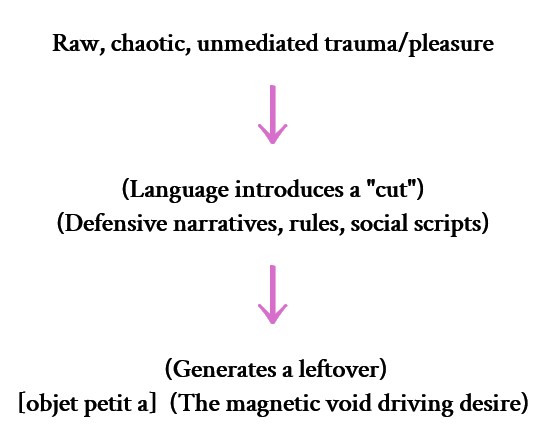
The Real is the starting point of existence. It is not “reality” as we perceive it; rather, the Real is raw, unmediated, pre-language existence. It is the realm of pure biology, unshielded trauma, mortality, and intense, overwhelming physical pleasure (jouissance). The Real is utterly indifferent to our feelings, resists words absolutely, and contains no neat stories or comfortable limits.
Because looking directly at the Real of existence would drive us mad, humanity constructs the Symbolic Order: the world of language, social rules, laws, and narratives. Lacan’s central claim is that the unconscious is structured like a language. This means that all human narratives are defensive structures; they are ideological scripts we write to introduce a “cut in the Real” and bring order to a chaotic universe. We tell stories so we do not have to face the terrifying, unvarnished truth of existence head-on.
When we enter this world of language, we are severed from the Real and become what Lacan termed the split subject, written as:
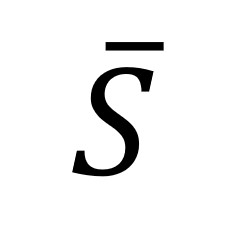
To cope with this split, we spend our lives chasing the objet petit a—the “object-cause” of desire. The *objet petit a* is not a physical object we want to possess; it is the empty space, the “donut hole” or the structural leftover created when language sliced into our pre-verbal wholeness.
Online pornography is the ultimate, high-definition Symbolic Shield of our era. The raw Real of actual human intimacy is terrifyingly vulnerable. It involves the risk of rejection, the exposure of physical flaws, performance anxiety, and the overwhelming, unpredictable presence of another conscious subject.
To avoid this chaotic encounter with the Real, we turn to the screen to live out an “Interpassive Script.” The philosopher Slavoj Žižek points out that digital media excels at interpassivity; allowing an object or machine to experience our feelings on our behalf, relieving us of the active, vulnerable duty of real enjoyment. Some examples of interpassivity are:
1. Sitcom Laugh Tracks: The laughter on the recording serves as a “chorus” that laughs for us, allowing us to feel amused even if we are tired or distracted.
2. Tamagotchi (the egg-shaped virtual pet toy): We delegate the emotional labor of caretaking and the anxiety of responsibility to a digital pet that “demands” attention, simulating a relationship while you simply press buttons.
It is important to note that this is not to categorize interpassivity as mere laziness or convenience. Consider if they actually function as a protective psychological buffer; a way to maintain the appearance of commitment (to faith, to a pet, to culture) when we lack the psychic energy to perform it authentically.
A further example is in pornography: we stare at a screen where the performers experience intense passion in our place. We don’t have to risk the Real of a human partner; we can delegate our desire to a safe, predictable, and fully categorized symbolic fantasy.
A visual trick holds us captive: the female performer breaks the fourth wall by looking directly into the camera lens. This eye contact subverts the traditional “male gaze.” We struggle to maintain our autonomy while we watch content. The screen captures our focus by demanding total attention. Our gaze becomes trapped within this rigid digital structure. This machine dictates our emotional responses through a totalizing visual regime. We sacrifice our agency to this synthetic environment.
The screen constructs a defensive script for us. Consequently, such simulations promise complete satisfaction. Yet, we remain confined within a passive and digital cage. Moreover, users delegate their internal experiences to this cold machine. Ultimately, humans avoid the raw vulnerability found in the Real. Does this cycle replace authentic connection with a predictable simulation?
The Copied Script: René Girard and the Mirror of Mimetic Desire
If the Symbolic Order is a defensive system of narratives, where do we get the words and scripts for our desires? The French anthropologist René Girard proved that we do not write them ourselves. He argued that human desire is inherently mimetic, or imitative. We do not desire objects spontaneously; we watch other people (our “models”), and we copy what they want.
Girard called the belief that our desires are entirely original and spontaneous “The Romantic Lie.“ In truth, we are chasing “metaphysical desire,” we do not want the object itself, but rather the perceived state of being, the confidence, and the happiness of the model who possesses it
Again, pornography acts as a massive factory for this Mimetic Script. The viewer is not merely watching biological copulation; they are witnessing a theatrical performance of intense desire between two actors who are mutually validating each other as ultimate objects of desire. Through the screen, the spectator copies this desire, experiencing ontological desire: the wish to step into the actor’s body and acquire their effortless, edited state of being.
But this mimetic copy-pasting comes with a severe psychological tax: mimetic rivalry. We mimic impossible, highly edited digital models. Comparison drives us to measure our vulnerable bodies against the screen. Consequently, we perceive our real relationships as lacking. René Girard observed a quiet, modern hysteria arising from this dynamic. This trend fuels a dramatic rise in intimacy issues. Many of us struggle with sexual performance anxiety. Furthermore, rates of impotence continue to climb.
We become terrified of the “non-desire of the other”; the constant, exhausting fear that we do not measure up to the digital standard, or that we don’t experience desire “correctly.”
To manage this collective anxiety, our culture uses pornography as a “scandalous anchor.” Just like ancient societies used scapegoats to discharge collective tension and restore social order, pornography regulates our daily stress, loneliness, and exhaustion by channeling our desires into isolated, self-sufficient loops . It keeps our anxiety quiet, but it does so by locking us in a room alone with a screen, isolated from the very communities we need to build genuine connection.
Time to Reflect: If your mind has been unconsciously copying the desires of the digital “models” on your screen, how much of your daily anxiety about your relationships, your body, and your lifestyle actually belongs to your lived experience of the Real, and how much of it is a copied performance you are trying to measure up to?
How to Stop Compulsive Scrolling: The Commodification of the Current | Deleuze, Guattari
The radical philosophers Gilles Deleuze and Félix Guattari offered a beautiful, liberating alternative to the idea that desire is just a “lack” or a hollow space. They argued that desire is a positive, wild, highly creative, and productive current. They defined our minds and bodies as “desiring-machines.”
Desire does not want to own or possess anything; it simply wants to connect, explore, build, and flow. It is the raw, pre-personal energy that drives us to paint, write, construct communities, and fall deeply in love.
But under our modern capitalist system, this wild, creative flow is highly dangerous to the status quo. A system built on endless consumption doesn’t want wild, unpredictable, and self-sufficient human energy; it wants predictable consumers.
Therefore, digital platforms and algorithms are designed for what Deleuze and Guattari called capture and reterritorialization. They take your wild, chaotic creative energy and channel it into standardized, clickable, monetized boxes.
Under contemporary capitalism, “strategies of capture, control and machinic enslavement” name how capitalism both follows deterritorializing lines (freeing labor/capital) and then develops reterritorializing forces to stabilize and exploit these flows (e.g., transforming subjectivity into an input for value extraction).
Online pornography is a textbook example of this assembly line of joy. Your deep, mysterious human drive for connection, intimacy, and raw exploration is broken down, decoded, and repackaged into rigid search categories, tags, and algorithmic recommendations.This creates a sort of captured script: a story that limits your vast, creative potential, convincing you that your desire can only be expressed and satisfied by clicking a specific folder, watching a specific category, and consuming a digital product.
Instead of letting our desires energies flow outward to build a creative life, write a book, or navigate a deep relationship, the machine captures our desires and confines it to a private screen. Our unique human potential is turned into a predictable, passive consumption loop.
Let us reflect: if our natural desire is a wild, creative current rather than a broken engine, what has happened? The digital assembly line of algorithms, tags, and folders restricts us. It prevents us from building, writing, or expressing ourselves in physical reality. We must identify exactly what has been stifled.
How to Stop Compulsive Scrolling: Re-Writing the Script by Symbolizing the Real
This is where the profound connection to Narrative Therapy comes alive. Narrative Therapy, developed by Michael White and David Epston, is not just a clinical tool; it is a philosophy of language that directly mirrors the psychoanalytic understanding of the mind.
Lacan identified psychological distress as a “symbolic deficit.” We interpret this as a painful gap. It exists when lived experiences defy the dominant language of our culture. If we struggle with how to stop compulsive scrolling, we must recognize a truth. Lacan is not pathologizing; he highlights our fundamental state of being. Raw, un-narrated pain eventually irrupts into our lives. This force cracks our neat symbolic stories. It creates an opening for the Real. This is an irruption of the Real.
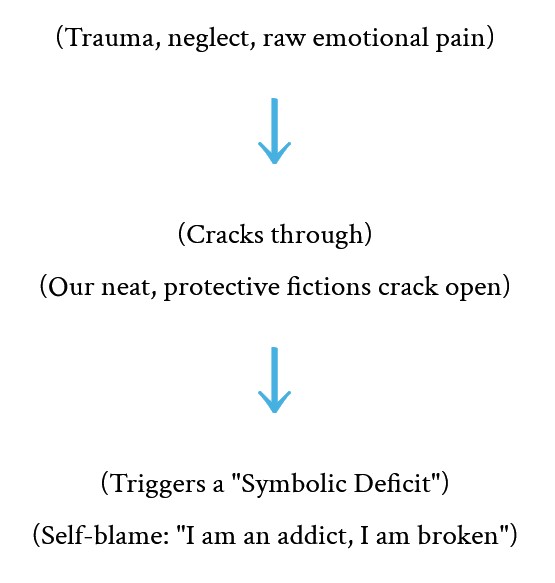
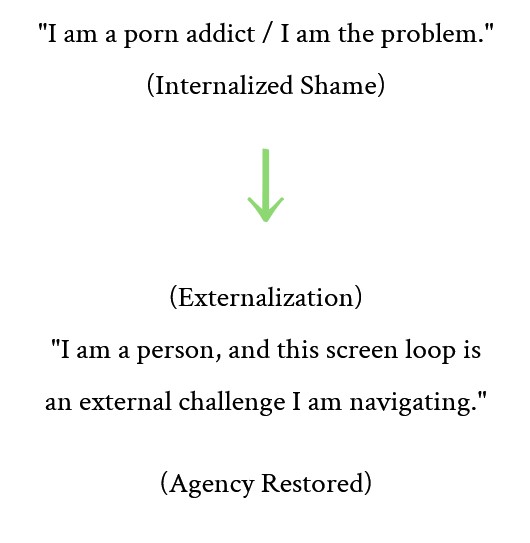
When this crack occurs, we experience a profound sense of void . Because we lack the “experience-near” language to express this raw pain, we swallow the dominant, pathologizing narratives of our culture. We tell ourselves a “thin, problem-saturated story” that fuses our identity with our struggle: “I am a porn addict. I am a failure. My brain is broken.”
In other words, we mistake the defensive symbolic script we used to survive the Real for our actual, living self. The compulsive behavior (pornography, scrolling, binging) was just a desperate, clumsy attempt to use a symbolic shield to protect ourselves from a – Real – pain we could not name.
Narrative Therapy resolves this symbolic deficit through externalization. It operates on the premise that the person is not the problem; the problem is the problem.
Separating identity from behavior transforms a habit into an external character. Consequently, this force loses its grip on our personal narrative. Such detachment creates vital, metacognitive distance. Furthermore, change flourishes through this specific shift in perspective. We then set down our defensive shield. Symbolizing the Real of our pain on our own terms follows. Ultimately, clinical labels no longer dictate our reality.
The 4 Steps to Map and Re-Write Your Story:
Using Michael White’s structured mapping process, we can take the pen back from the digital screen and co-construct a “suppléance”; a stabilizing, highly personalized alternative narrative that honors our lived experiences:
- Name the Script (Experience-Near Naming): Toss out dry, pathologizing labels like “addiction” or “hypersexuality.” Give your habit a creative, external name that describes how it actually operates in your life. You might call it “The Silent Companion,” or the “The Mimetic Ghost.”
- Map Its Influence: Document how this “Mimetic Ghost” has written itself into your life. When does it sneak into your room? How does it try to convince you that the Real of human contact is too exhausting? How does it distract you from your creative project?
- Evaluate Its Effects: Reclaim your authority as the author of your life . Do you like what it does with your time, your energy, and your actual capacity for face-to-face vulnerability?
- Uncover the plot holes. Look for “unique outcomes” or “sparkling moments” in your history. These occur when the Real bursts through. Instead of choosing a screen, we sit with our feelings. Sometimes we call a friend or create art. Such exceptions provide raw material for an alternative story of agency. They cultivate true connection.
To facilitate this process, modern therapy can create a safe, creative space where you can look your habits in the eye, talk to them, set boundaries, and realize they are much smaller and less powerful than you think.
Consider this question: Is your screen habit just a clumsy, defensive shield? It protects you from raw pain in the Real. What un-narrated loneliness or trauma is “The Mimetic Ghost” hiding from you? It is time to learn how to stop compulsive scrolling by facing this hidden reality.
Conclusion: Stepping Off the Screen and Into the Real
Desire is not a prison, and we are not broken machines. The digital world wants us to believe “The Romantic Lie” that our screen cravings are entirely our own. It wants us to settle for interpassivity: letting pixels and algorithms enjoy our lives on our behalf while we watch silently from the sidelines.
But real intimacy, real joy, and real creative power cannot be found on a standardized, categorized screen. Real life lives in the Real: in the beautifully messy, unedited, and unpredictable spaces of genuine human connection, where we dare to look at each other without a filter.
First, we reclaim our agency. By stepping out of digital loops, we discover how to stop compulsive scrolling. Simultaneously, we move into the vulnerability of the present. Next, we externalize the “Mimetic Ghost” to map its tricks. Through this process, we reclaim our wild, productive energy. Finally, we step off the digital assembly line; after all, you are the author of your life story, and the screen is just a screen.
If you have questions, concerns, or if you are ready to begin writing the next chapter of your life, we invite you to reach out to Luceris. We are here to help you move past the mimicry and reclaim the agency that is rightfully yours.