

The current state of mental health research in the mid-2020s reveals a paradox of progress. While clinical symptoms of depression and anxiety among younger demographics, particularly college students, have shown a measured decline over a three-year period, the qualitative sense of “flourishing,” the presence of purpose, self-esteem, and optimism, has concurrently stagnated or declined. As of 2025, approximately 37% of students report moderate to severe depressive symptoms, an improvement from 44% in 2022, yet only 36% report high levels of psychological well-being. This disconnect suggests that the mere reduction of pathology is insufficient for the mastery of the internal emotional landscape.
Globally, the human population remains on what researchers describe as an “emotional edge,” with 39% of adults reporting significant daily worry and 37% experiencing high stress. These pressures are exacerbated by a pervasive sense of social disconnection, with half of the adult population just in the United States feeling isolated or lacking companionship. Bridging this gap requires moving beyond basic coping mechanisms and adopting proven emotional regulation techniques.
Against this backdrop, the ability to regulate emotions, to monitor, evaluate, and modify emotional reactions, becomes a primary determinant of health and longevity. Emotional regulation is not a static trait but a complex developmental achievement that spans the human lifecycle. It is influenced by the “internal lens” through which feelings are interpreted and the “meta-cognitive” blueprints that dictate how an individual responds to their own internal states. Mastering this process requires a deep dive into the evolution of emotional skills, the theoretical models of processing, and the practical application of strategy-situation fit.
The Developmental Trajectory of Emotional Skills
The evolution of emotional regulation begins in the fetal stage and undergoes its most significant transformations during infancy, childhood, and emerging adulthood. The biological foundations are laid through the maturation of the amygdala and the prefrontal cortex, a process shaped by a continuous interplay between genetic predispositions and the caregiving environment.
Infancy and the Foundation of Co-regulation
In the earliest stages of life, human neonates possess innate stress responses but lack the capacity for independent emotional regulation. They are entirely dependent on “co-regulation,” a supportive process where caregivers monitor infant distress and provide external interventions to regain physiological equilibrium. By two months, infants begin to develop social signaling, such as smiling to elicit engagement, which serves as an early form of influencing their emotional environment. By six months, they show awareness of familiar faces and begin to respond to the emotions of others, reflecting the emergence of social-emotional literacy.
The transition from external regulation to initial self-regulation occurs in the toddler years. Between 18 and 30 months, children gain motor and linguistic skills that allow them to physically move away from loud noises or use basic words to request comfort. However, their emotional intensity at this stage far outweighs their regulatory capacity, resulting in the characteristic temper tantrums of early childhood as they struggle with communication and independence.
Childhood: The Emergence of Strategic Control
The preschool years (ages 3 to 5) mark a critical milestone: the ability to reflect upon and talk about feelings. This linguistic development transforms emotions from raw physical experiences into objects of thought that can be negotiated. During middle childhood (ages 6 to 12), children become capable of “strategic self-control.” They learn to redirect their attention away from distressing stimuli, such as ignoring a scary image, and begin to understand that their internal feelings can be masked to meet social expectations. This period is characterized by a growing awareness of others’ perceptions and the refinement of empathy, which informs more complex social-emotional interactions.
Adolescence and the Theory of Personal Emotion
Adolescence introduces a “theory of personal emotion,” an integrated internal framework for understanding how emotions function within the self. This stage is defined by the construction of self-referent beliefs and the use of idiosyncratic regulatory strategies, such as using music or mental imagery to manage moods. The development of the prefrontal cortex continues into early adulthood, enhancing the capacity for “top-down” control and the ability to navigate complex social conflicts.
| Developmental Stage | Primary Regulation Mechanism | Key Milestones |
| Infancy (0-12 months) | External Co-regulation | Social smiling, stranger anxiety, responding to others’ affect. |
| Toddlerhood (1-3 years) | Initial Self-Regulation | Simple pretend play, use of words for needs, emergence of defiance. |
| Preschool (3-5 years) | Linguistic Regulation | Talking about feelings, negotiating with peers, developing empathy. |
| School-Age (6-12 years) | Strategic Control | Hiding expressions, redirecting attention, understanding distinct perspectives. |
| Adolescence (13-18 years) | Personal Emotion Theory | Introspection, idiosyncratic mood management, identity formation. |
Emotional Regulation Techniques and the Aging Brain: The Positivity Shift
While emerging adulthood (ages 18-25) is often a period of high stress and uncertainty, it is also a time for the refinement of adaptive strategies like planning and positive re-evaluation. Interestingly, longitudinal (long-term) data suggest that emotional regulation often improves with age. This “positivity effect” manifests as older adults prioritizing present-oriented emotional goals and demonstrating a superior ability to attend to and remember positive information while filtering out the negative.
The Internal Lens: Comparative Models of Emotional Processing
How an individual experiences and responds to an emotion is dictated by their “Internal Lens,” the underlying theoretical framework they apply to their internal states. Research identifies three primary models that significantly impact long-term well-being: the Ventilation Model, the Emotionally Focused Model, and the Cognitive Model.
The Ventilation Model: The Hydraulic Approach
The Ventilation Model, which researchers often associate with early psychodynamic theories, views emotions as a form of pressure or energy that individuals must “let out” to prevent mental distress. The model assumes that greater emotional expression produces a better psychological outcome. However, contemporary evidence indicates that this “hydraulic” view is incomplete. So, while emotional expression can provide a sense of release, clinical studies show that catharsis alone often increases physical arousal and negative affect immediately. Researchers have not found a significant correlation between a strict ventilation approach and reduced symptoms of depression or anxiety, suggesting that “just getting it out” cannot substitute for processing the meaning behind the feeling..
The Emotionally Focused Model: Feelings as Information
The Emotionally Focused Model suggests that emotions are essential forms of information processing. They contain a “truth” about an individual’s needs and the meaning of external events. From this perspective, physical emotional pain is viewed similarly to physical bodily pain: it signals that something is wrong and needs to be changed. The focus of this model is on the activation, expression, and validation of feelings to facilitate self-understanding and acceptance. Validation, whether from oneself or a supportive audience, serves as a key component; it reduces guilt and rumination while helping individuals see their emotions as more comprehensible and controllable.
The Cognitive Model: The Meta-Cognitive Framework
The Cognitive Model of emotional processing emphasizes that individuals differ not in what they feel, but in how they think about what they feel. This framework centers entirely on “meta-cognition,” or thoughts about thoughts. To clarify, the model distinguishes between two completely different pathways: normalizing an emotion or pathologizing it. If an individual views an emotion like anger as “normal,” for instance, they can move quickly toward acceptance and growth. Conversely, labeling a standard human feeling as “dangerous” triggers a toxic cycle of cognitive avoidance. This internal resistance can subsequently lead to deep dissociative behaviors, bingeing, or emotional numbness. Ultimately, clinical data strongly validate this approach, proving that our internal interpretations dictate our anxiety levels far more than the raw feelings themselves.
| Processing Model | Core Philosophy | View of Emotion | Research Outcome |
| Ventilation | Catharsis | Pressure to be released | Mixed; can increase arousal. |
| Emotionally Focused | Information | A “truth” to be understood | Strong links to self-understanding. |
| Cognitive | Meta-Cognition | A process to be conceptualized | Best predictor of anxiety/depression. |
The Mind’s Blueprint: How Beliefs Shape Well-being
The “Internal Lens” is made up of several dimensions of belief, often referred to as a “Mind’s Blueprint” (clinically known as cognitive schemas). These internal “rules” determine how we judge our feelings and significantly impact our mental health. Some of these beliefs in our Internal Lens are as follows:
The Trap of Guilt Over Feelings
One of the most challenging beliefs in the Mind’s Blueprint is the idea that certain feelings are “wrong” or “shameful” to have. This meta-guilt creates a sense of being “bad” for experiencing normal human reactions. Research shows that higher levels of guilt over emotions are significantly related to both depression and anxiety. Indeed, when people feel ashamed of their feelings, they often try to “guard” against ever experiencing them again. This defensive wall, however, paradoxically makes the emotions more persistent and intense. Consequently, individuals are far more likely to blame others for their internal distress. As a result, they remain trapped in the very pain they are desperately trying to avoid.
The “Fear of Forever”: Duration Beliefs
The belief that a strong emotion will last indefinitely is a primary driver of hopelessness. Specifically, psychologists refer to this misconception as a “duration” belief. Individuals who fear that a painful feeling will never go away if they acknowledge it run a much higher risk for depression. In reality, however, intense emotions operate just like ocean waves. They only last a short period if you allow them to pass through your mind without resistance. Instead of drowning you, they peak and naturally recede. Validation from others is the most effective tool for shortening the perceived duration of an emotion, as it helps the individual recognize that the feeling is a temporary response to a specific situation.
The Sense of “Weirdness”: Lack of Consensus
Many people suffer from the belief that their emotional responses are unique or “weird,” a state known as Low Consensus. This is the thought that “I respond with feelings that others would not have”. This belief is a strong predictor of social isolation and clinical anxiety. Recognizing that emotions are a “common humanity,” that others feel the same range of anger, sadness, and fear, is essential for normalization. People who believe their feelings are similar to those of others (High Consensus) report better emotional control and lower levels of distress.
Simplistic and Overly Rational Viewpoints
The Mind’s Blueprint also dictates our core beliefs about how complex our feelings are allowed to be. For example, a “simplistic view” demands absolute certainty about an internal state. This rigid mindset makes it incredibly difficult to tolerate ambivalent emotions, such as simultaneously loving and feeling angry with the same person.
Similarly, an “overly rational” approach pressures individuals to prioritize cold logic over sensitivity. Adopting this hyper-focused framework can ultimately cause profound emotional numbness. Logic certainly holds immense value, but completely ignoring the raw truth of your emotions destroys self-understanding. As a result, burying these internal signals spikes somatic stress and dramatically increases long-term health risks.
| Mental Blueprint Dimension | Internal Rule | Impact on Well-being |
| Guilt | “This feeling is wrong/shameful.” | Increases depression and anxiety. |
| Duration | “This feeling will last forever.” | Primary predictor of hopelessness. |
| Consensus | “My feelings are weird/unique.” | Leads to isolation and chronic worry. |
| Simplistic View | “I must be 100% sure how I feel.” | Increases mood volatility. |
| Overly Rational | “Logic is better than feelings.” | Leads to numbness and somatic pain. |
Emotional Regulation Techniques: Six Aspects to Mastering Your Reactions
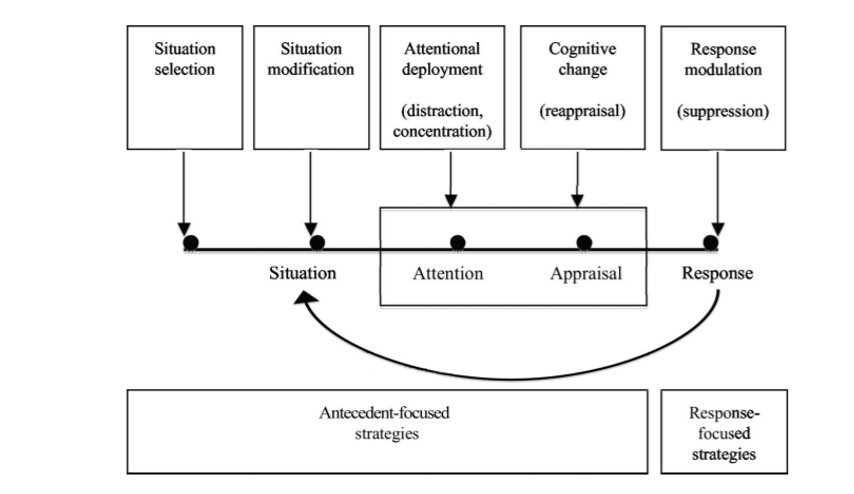
To transform these insights into action, clinical researchers utilize the Process Model of Emotion Regulation. This model breaks down the timeline of an emotional experience into five intervention points. To make this accessible, it is helpful to translate clinical terms into “everyday language.”
Step 1: Choose Your Environment (Situation Selection)
The earliest and most effective intervention happens before you even encounter a trigger. Situation selection is all about proactively deciding which environments to enter or avoid based on how they affect your mental state. Think of it as engineering your day for stability. For instance, if you know a specific family member always sparks a heated political argument, declining a dinner invitation when you’re already exhausted isn’t avoidance but in specific cases it can be about smart emotional management.
Step 2: Alter Your Surroundings (Situation Modification)
You cannot always opt out of a stressful situation, but you can certainly alter its physics once you are in it. When a scenario begins to feel overwhelming, therefore, you must look for ways to modify the immediate environment to dial down the intensity. If a workplace meeting turns overly contentious, for instance, you do not have to just sit through the spike. Instead, you can proactively suggest a five-minute coffee break or shift the agenda to a more neutral topic.
Step 3: Manage Your Focus (Attentional Deployment)
Clinical literature calls this “attentional deployment,” but practically speaking, it is the art of directing your mental spotlight. When an external stressor is unavoidable, you still control where your energy goes. Consider how people handle a painful medical procedure: rather than hyper-focusing on the needle, they might stare intently at a pattern on the ceiling or lose themselves in a podcast. By intentionally deploying your attention, you starve the stressor of the cognitive fuel it needs to grow.
Step 4: Re-evaluate the Story (Cognitive Change)
This is the final checkpoint before an emotion takes full physical root in your body, often referred to as “reappraisal.” It relies on a simple truth: we don’t react to facts; we react to the stories we tell ourselves about those facts. When a friend goes silent for six hours after a vulnerable text, the default narrative might be, “They’re ignoring me.” Reappraisal is pausing to consider alternative, less threatening explanations: “They’re likely jammed at work and haven’t seen it yet.” Reframing the narrative fundamentally changes the emotional output.
Step 5: Handle the Aftermath (Response Modulation)
Whenever a trigger slips past your proactive defenses, you immediately enter the reactive phase. Response modulation helps you manage the physical fallout after your internal chemistry changes. This is consequently the exact moment where physiological interventions come into play. If a frustrating day leaves your heart racing, for instance, you must handle that outcome through direct action. You might go for a brisk run to burn off spiked cortisol. Instead, you could use deep breathing so that your nervous system knows the danger has passed.
Step 6: Integrate and Learn (Adaptive Engagement)
While the first five steps navigate the immediate lifecycle of an emotion, the final stage is the most critical. Clinical psychologists call this process integrative emotion regulation. Instead of trying to escape the feeling, this step requires you to drop your defenses entirely. Consequently, you learn to accept, validate, and express exactly what is happening inside.
When you stop fighting a difficult emotion, it also stops fighting you. Validation simply means acknowledging your internal state without passing judgment. You might tell yourself, for instance, “It makes complete sense that I feel hurt right now.” Subsequently, constructive expression lets the emotional energy safely leave your system. You can achieve this through journaling, somatic release, or vulnerable communication. Ultimately, this practice turns terrifying disruptions into valuable educational data. Letting the feeling pass through you completely allows you to unlock its deeper lesson. This insight then teaches you about your boundaries, your values, and what you truly need to heal.
| Stage | Everyday Name | Proactive vs. Reactive | Key Question |
| Situation Selection | Choosing Environment | Proactive | “Should I put myself in this situation?” |
| Situation Modification | Changing Environment | Proactive | “How can I change the circumstances?” |
| Attentional Deployment | Focus Management | Proactive | “What am I focusing on right now?” |
| Cognitive Change | Re-evaluating Story | Proactive | “How else could I look at this?” |
| Response Modulation | Managing Outcome | Reactive | “How do I handle the feeling now?” |
| Adaptive Engagement | Integrate and Learn | Proactive | “What is this feeling trying to teach me about my boundaries, my values, or what I need to heal?” |
Brief Neurobiological Foundations
The biological hardware for emotional regulation relies on a “top-down” control system. The amygdala acts as the brain’s rapid-response alarm system, processing emotional stimuli and triggering the “fight-or-flight” response. The prefrontal cortex (PFC) serves as the “executive center,” responsible for reasoning, logic, and the implementation of strategies like Focus Management and Re-evaluation.
In a well-regulated brain, the PFC sends inhibitory signals to the amygdala to “cool down” its activity. However, this system is resource-heavy. Factors like chronic stress, systemic inflammation, or lack of sleep can “offline” the PFC, leaving the amygdala in a state of hyper-reactivity. Consistent practice of regulation skills actually increases the density of neurons and the functional connectivity between these regions, making the brain more efficient at managing stress over time.
Emotional Regulation Techniques: Distancing and Reappraisal
Beyond the six aspects, individuals can employ advanced cognitive tools to change their relationship with their thoughts.
Cognitive Distancing: The “Sunglasses” Metaphor
Distancing is the process of recognizing that thoughts are merely mental events rather than absolute facts. A powerful metaphor for this is wearing colored sunglasses. If you wear yellow sunglasses long enough, you forget you have them on and believe the world is yellow. Distancing is like taking the glasses off and holding them a few inches away from your face; you can still see the yellow tint, but you realize it is a property of the lens, not the world. In practice, this looks like shifting language from “I am a failure” (Identifying) to “I am having the thought that I am a failure” (Distancing). This small shift creates the psychological space necessary to re-evaluate the thought objectively.
Reappraisal: The Strongest Predictor of Well-being
Re-evaluating the story (reappraisal) is consistently cited in clinical literature as the most effective strategy for long-term health. Individuals who habitually use reappraisal experience more positive emotions, fewer symptoms of depression, and better social functioning. It works by converting an externally imposed burden into a chosen duty or a learning opportunity. For example, viewing a difficult breakup not as a “waste of time” but as a “necessary lesson in personal boundaries” significantly reduces the associated emotional distress.
Emotional Regulation Techniques vs. The Hidden Costs of Emotional Suppression
While “Managing the Outcome” (Aspect Six, Response Modulation) is sometimes necessary in professional settings, the habitual use of Expressive Suppression, intentionally hiding the outward signs of an emotion, carries significant costs.
Social and Relational Fragmentation
Emotional suppression is incredibly “toxic” to relationships. Specifically, because suppressed individuals mask their internal states, others perceive them as less authentic and less likable over time. Interacting with someone who hides their feelings is also highly stressful for the other person. In fact, clinical studies show that a partner’s blood pressure increases whenever they sense their companion is holding back. This invisible tension ultimately fractures social bonds and destroys relational intimacy. This leads to lower social support, less closeness, and a general decrease in life satisfaction.
Physical Health and the Allostatic Load
Consistent suppression requires massive physiological effort, contributing to “allostatic load,” the wear and tear on the body from chronic stress. Habitual suppressors have higher levels of C-reactive protein (a marker of inflammation) and are 10% more likely to develop cardiovascular disease (CVD) over a decade. Suppression does not eliminate the internal experience of the emotion; it merely traps it inside, creating a high-arousal internal state that can lead to hypertension, heart disease, and impaired immune function.
| Strategy | Social Impact | Physiological Impact | Long-term Outcome |
| Reappraisal | Increases closeness and trust. | Reduces blood pressure and stress. | Better mental and physical health. |
| Suppression | Decreases social support. | Increases inflammation and BP. | Higher risk of CVD and isolation. |
Emotional Regulation Techniques: The Role of Sleep and Exercise
Emotional regulation is significantly influenced by the physical state of the body. Sleep and exercise act as “force multipliers” for our mental regulation skills.
The Sleep-Emotion Connection
Sleep is when the brain restores its emotional balance and consolidates experiences. Even partial sleep deprivation can cause the amygdala to become up to 60% more reactive to negative information. This creates a “vicious cycle”: lack of sleep makes us more anxious and irritable, and that heightened anxiety makes it even harder to sleep. People with chronic insomnia are five times more likely to develop depression and twenty times more likely to develop panic disorder. Prioritizing “sleep hygiene,” consistent schedules and calming routines, is a cornerstone of emotional regulation.
Exercise as “Meditation in Motion”
Physical activity is a powerful tool for regulation because it directly influences neurochemistry. Aerobic exercise pumps up endorphins and serotonin, which elevate mood and act as natural “stress relievers”. More importantly, exercise increases brain-derived neurotrophic factor (BDNF), which promotes neuron growth in the PFC and hippocampus, the regions responsible for top-down emotional control. By exposing the body to “controlled stress” (physical exertion), exercise teaches the nervous system how to recover from arousal more efficiently.
Emotional Regulation Techniques: Conclusions and Practical Integration
Mastering emotional regulation is a holistic, lifelong process. Specifically, it requires you to understand the evolution of your feelings, map your “Mind’s Blueprint,” and apply proactive strategies before stress takes over. Moving away from a ventilation-style “hydraulic” view is essential for long-term health. Instead of simply letting off steam, we must adopt a cognitive meta-framework. Indeed, our internal rules regarding guilt, duration, and consensus are often completely distorted. But once we recognize these biases, we can consciously rewrite the script of our internal life. Ultimately, this shifts our mindset from fighting our feelings to understanding them.
Final Recommendations for Emotional Mastery:
To summarize, here are five recommendations based on research that can help begin our journeys to become effective at emotionally regulating:
- If you feel “weird” for having a certain feeling, seek consensus. You will likely find that your reaction is a normal human response shared by millions.
- The next time you feel a spike of anxiety from a social interaction, re-evaluate the story. Is there a more neutral explanation?.
- Instead of “I am angry,” say “I am noticing a feeling of anger.” This small change in language “takes the yellow sunglasses off”.
- Seven hours of sleep and thirty minutes of movement provide the “biological bandwidth” your prefrontal cortex needs to keep you in control.
- Find a trusted listener or be a supportive audience for yourself. Validating a feeling is the fastest way to shorten its perceived duration.
By integrating these strategies, we can move from being passive recipients of our emotions to being active architects of their internal well-being.
Please feel free to reach out if you have any questions or concerns. If you’re ready to take the next step, you can book a session with Luceris. Together, we’ll work as a team to explore areas for growth and help you master emotional regulation.