
Most people have experienced wanting something to change while also feeling a strong pull to stay where they are. This tension is often at the core of fear of change. They may want to leave a painful relationship, speak more honestly, set a boundary, or live in a way that feels more aligned with who they are. At the same time, we may hesitate, resist, and the familiar starts to feel safer than the future we thought we wanted. This can be frustrating, especially when the reasons for change seem obvious. It can also become a source of self-judgment. People often assume that if they truly wanted change, they would simply act.
Psychology has never fully supported that simple view of the mind. Human beings do not move through life with one motive or one uninterrupted line of intention. We are shaped by competing needs, old learning, emotional memory, present pressures, and the conditions in which our lives are lived. This is where dialectics becomes useful. At its broadest, dialectics is a way of understanding reality as dynamic, interconnected, and shaped by tensions that generate movement. Instead of treating contradiction or paradoxes as a mistake, dialectical thinking treats it as meaningful. Opposing forces do not always cancel each other out. Often, they reveal how change happens.
This idea appears in different forms across philosophy, political economy, and psychotherapy. Georg Wilhelm Friedrich Hegel wrote about dialectics, which describes how a position can contain its own limits. A person, idea, or way of seeing the world may seem stable at first, but over time its one-sidedness becomes harder to sustain. What appears as its opposite begins to emerge. People are often introduced to this through thesis, antithesis, and synthesis. Even if Hegel’s actual method is more precise, the central point remains useful here. A position meets its contradiction, and that tension gives rise to something more developed.
Marx grounds this dialectical structure in material life. He is less concerned with contradiction inside ideas than with contradiction inside real social relations, especially those shaping work, class, survival, and power. People do not struggle in the abstract. They live inside systems that contain tensions within themselves. This matters psychologically because resistance to change is not formed only inside the individual mind. It is also shaped by lived conditions. Fear of change often reflects more than private insecurity. It also reflects the conditions that taught a person what change might cost.
In Dialectical Behaviour Therapy (DBT), dialectics becomes a practical psychological method. The task is not to win an argument between opposite sides of experience, but to hold them together long enough to respond more effectively. The clearest example is the dialectic between acceptance and change. A person may need to recognize that their pain is real and understandable, while also changing the behaviors that keep them trapped in suffering. If therapy leans only on acceptance, a person may remain stuck. If it leans only on change, they may feel pressured or misunderstood. DBT treats the tension itself as central.
This matters because wanting change and fearing change is often where people remain stuck for years. One part of the self moves toward growth, relief, honesty, freedom, or repair. Another is organized around safety, predictability, attachment, dignity, or survival. Both often make sense. Both are trying to protect something.
This blog uses dialectics as its main method for understanding that tension. The blog begins by examining why change creates inner conflict even when it is needed. It then turns to Hegel, Karl Marx, and DBT to show how contradiction emerges, how real conditions shape it, and how people can work with it in therapy. The later sections explore what resistance to change is trying to protect, why familiar pain can feel safer than uncertainty, and how therapy can help people move through change with more stability.
The goal is not to make fear of change disappear through theory alone. It is to make the experience more understandable. Once that happens, resistance can begin to look less like failure and more like something that can be examined, worked with, and gradually transformed.
Fear of Change: Why Change Creates Inner Conflict Even When You Know It Is Needed
Change becomes difficult when the structure you have been living inside no longer fully works, yet still feels necessary to preserve. That is often where inner conflict begins. Part of you recognizes that something in your life, identity, or way of coping cannot remain as it is. Another part resists because the existing structure once carried an important function. The threat is not always the change itself. It is often the loss of a pattern that has helped hold life together.
This is where dialectics becomes useful. People often meet Hegel through thesis, antithesis, and synthesis, but his deeper point is that a position becomes unstable because of a contradiction within itself. What first appears stable eventually reveals its limit. The contradiction is not brought in from outside. It develops from the inadequacy of the original form. A way of living reaches a point where it can no longer contain what it has become.
Psychologically, that matters because resistance to change often follows the same pattern. An older way of living becomes painful not because it was false, but because it was partial. It once protected, organized, or stabilized experience, but eventually begins producing costs it cannot resolve. The tension is not simply between two feelings. It is between an old structure that once helped and the life it can no longer fully hold.
Hegel’s idea of sublation goes further than the simple language of synthesis. Something is overcome but not simply discarded. It is negated and preserved at the same time. In therapy, this matters because change rarely works when people try to destroy the old pattern outright. The old structure usually contains something that once mattered. The task is not reversal, but transformation, carrying forward what was once protective in a form that no longer imprisons you.
Marx deepens this by placing contradiction in real historical conditions rather than in thought alone. Fear of change does not form only inside the mind. It develops through the conditions in which a person learns what survival, belonging, or recognition require. A person may know a change is needed, yet still feel the old structure tighten because real pressures made alternatives costly. People live contradiction before they ever theorize it.
DBT then turns this into a clinical method. It treats contradiction as the place where psychological work begins. Acceptance and change are both necessary because either one alone becomes distorted. Acceptance without change becomes passive endurance. Change without acceptance becomes pressure against the self. The task is to hold both long enough for a more workable response to emerge.
So when change creates inner conflict, that conflict is not necessarily a sign of failure. It may be a sign that an older structure of selfhood has reached its limit while still exerting its force. Hegel helps explain why this happens from within the pattern itself. Marx helps explain why the pattern is tied to real conditions. DBT shows why therapy must hold both the necessity of the old pattern and the necessity of moving beyond it.
Fear of Change: How Hegel Helps Explain Why Opposite Feelings Emerge During Change
Hegel is useful here because he does not treat contradiction as a mistake in thought. He treats it as something that reveals the limit of a position. A person begins from a way of understanding themselves or living their life that seems coherent enough to hold. Over time, that position shows its insufficiency. It cannot account for everything that experience is now bringing forward. What appears next is not just a competing feeling. It is the exposure of what the earlier position could not contain.
This is why the popular formula of thesis, antithesis, and synthesis only helps at the most basic level. Hegel’s deeper idea is closer to this: a determination is asserted, then its inner instability becomes visible, and thought is forced beyond it. In the language of his Science of Logic, a position passes over into its opposite because it cannot remain what it first claimed to be. The contradiction emerges immanently from within. That is the important point for therapy. Opposite feelings during change are often not random. They emerge because an older way of organizing the self has started to show its limit.
Again, his concept of Aufhebung, usually translated as sublation, makes this even richer. Something is negated, but also preserved. It is not simply destroyed. Hegel means that development does not happen by throwing away the earlier form as if it had no truth in it. The earlier form contained something real, but in a limited way. Change takes place when that partial truth is carried forward into a wider form that can hold more of reality than before.
Applied psychologically, this matters because when someone begins to change, the old pattern is rarely pure error. It usually contains a truth that once mattered. Restraint may have protected dignity. Control may have protected stability. Distance may have protected against injury. The problem is not that these were meaningless. The problem is that they became too narrow to hold the person’s life as it now is. So a contradiction appears. The person wants what the older form cannot give, yet still depends on what it once provided.
That is why opposite feelings emerge. One side remains loyal to the earlier structure because it still carries a logic of preservation. The other side appears because lived experience has already outgrown that structure. Hegel helps clarify that this is not mere indecision. It is the sign of a form of life becoming inadequate to itself.
He also helps explain why one contradiction often opens into others. Once the limit of a pattern becomes visible, the deeper assumptions holding it together start becoming visible as well. A person may think they are struggling only with one change, then discover that the real issue touches identity, dependence, recognition, or freedom. The contradiction expands because the original position was never isolated. It belonged to a whole way of understanding life.
So the next question is not only what in you resists change, but what larger conditions taught that older structure to feel necessary in the first place?
Fear of Change: How Marx Helps Explain Why Change Feels Threatening in Real Life
Marx matters here because he takes contradiction out of the realm of thought alone and places it inside real life conditions. A person does not resist change in the abstract. They resist change within a world that has shaped what feels safe, what feels costly, and what feels survivable. This is one of the most important differences between a merely personal reading of fear and a dialectical one. The tension is not just inside you. It is also between you and the conditions that formed you.
This is part of what Marx means when he shifts dialectics onto material life. In his method, contradiction is not a static clash between two ideas. It is a living tension inside a structure, and as that tension develops, it reveals deeper contradictions within the same system. What first appears stable carries strains inside it. Those strains expand, sharpen, and expose how the whole arrangement organizes itself. In political economy, Marx demonstrates this with capitalism. The system presents itself as orderly and productive, yet closer examination reveals its inner tensions more clearly.
They are not accidental. They belong to the system itself.
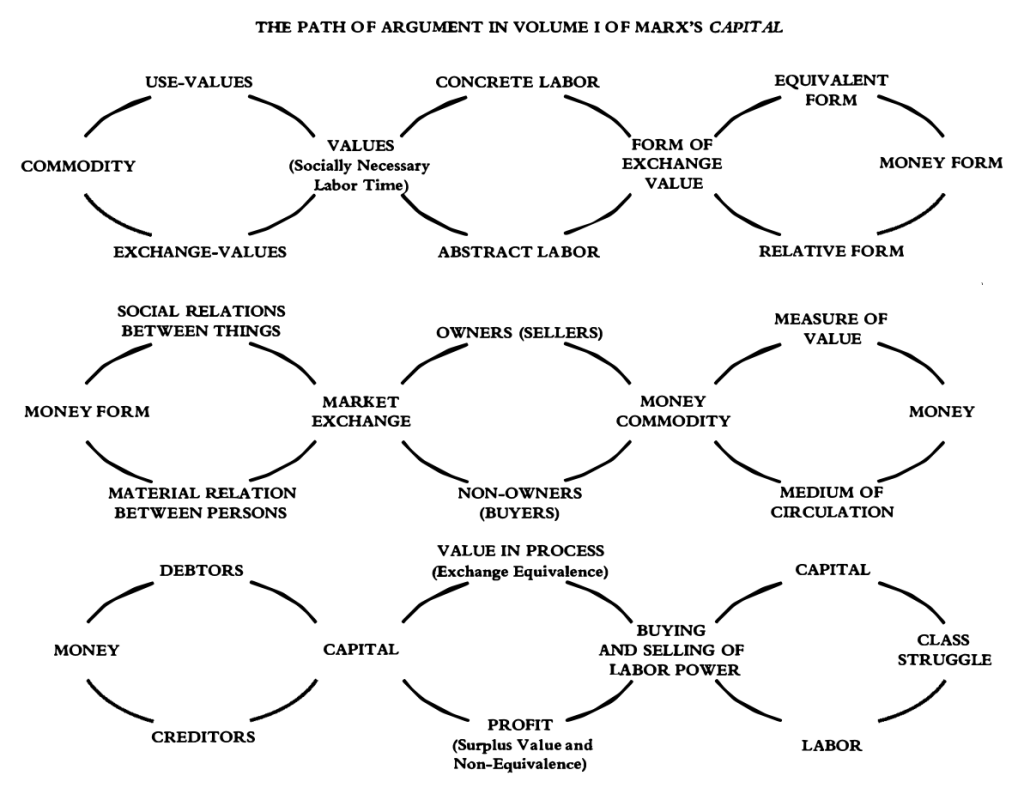
Psychologically, this matters because many people treat fear of change as if it were simply a personal weakness or an irrational attachment to the familiar. A Marxian lens makes the picture more serious. The familiar often became familiar under conditions that rewarded adaptation and punished deviation. A person may have learned that safety came through obedience, that worth came through productivity, that belonging came through self-erasure, or that emotional restraint was the cost of stability. Those patterns then become woven into the person’s way of living. When change begins to threaten them, the fear is not superficial. It is tied to the very structure through which the person learned to function.
This is where Marx helps deepen what Hegel already opened. Hegel shows how a form can reveal its own inadequacy from within. Marx asks what concrete relations gave that form its power in the first place. He forces the question of conditions. What pressures made this pattern necessary? Which functions did this way of living actually serve? What did it protect you from losing?
A person may say they want a different life, but if they built their current structure under demands that linked survival with compliance, performance, or control, then change will not feel like a simple opportunity. It will feel like a threat to the terms organizing their life.
This also helps explain why fear of change can feel disproportionate. The present moment may not fully justify the intensity of the fear, but the structure beneath it often does. The emotional reaction carries more than the current situation. It carries the history of adaptation. In that sense, the contradiction is not only between who you are and who you want to become. It is also between the life that shaped you and the life that is now asking something else of you.
That is why a person can remain loyal to a pattern that is already causing suffering. The loyalty is not stupidity. It is historical. The pattern belongs to a world of meanings, reinforcements, and consequences that once made it necessary. Marx’s dialectical method helps make that visible by showing that contradiction develops through the very structures that seem most normal. What looks settled begins to show strain. What looks personal begins to reveal a larger organization underneath it.
So when change feels threatening, the question is not only what contradiction is emerging within you. It is also what kind of world, family, role, or history made the old structure feel necessary enough to defend. If that is true, then what would it mean to hold both realities at once, the fact that the pattern once made sense, and the fact that it may now be deepening your suffering?
How DBT Teaches Dialectical Thinking in Therapy
DBT does not treat dialectics as a slogan. It teaches it as a skill. The point is not simply to tell clients that acceptance and change both matter. The point is to train them to notice when they have collapsed into one side, and to help them build a more workable response.
Therapists teach this through language. They encourage clients to shift from absolute, polar statements into formulations that can hold complexity. Instead of saying, “I either change right now or I’m hopeless,” therapists teach clients to say, “I need change, and part of me is scared of what change requires.”
Instead of “If this fear is here, I must not be ready,” the task becomes, “Fear is here, and I may still be able to move.” That shift sounds small, but it changes the structure of thought. It interrupts splitting and creates room for reflection.
DBT also teaches dialectics through validation. The therapist does not argue the client out of the old pattern too quickly. They identify the truth inside it. A fear of change may make sense given the client’s history, learning, or environment. Once the therapist names that truth, they add the second side. The pattern makes sense, and it now costs the client something. This is how therapists link acceptance and change in practice. Clients learn that they can understand themselves without remaining unchanged.
Another method is behavioural analysis, especially chain analysis. A client takes a moment where they resisted change or reacted strongly and breaks it down step by step: what happened, what thoughts appeared, what emotions rose, what urges followed, what action came next, and what the consequences were. This teaches dialectics because it shows that the behaviour was not random and not inevitable. The old response had a function, but it also had a cost. Once both are visible, a different response can be inserted at a specific point in the chain.
This video explains behavior chain analysis as a DBT tool used to break down the sequence of events that lead to a target behavior. It highlights how vulnerabilities, triggers, thoughts, emotions, and urges build toward the behavior, and emphasizes identifying intervention points to apply coping skills. A dialectical perspective is encouraged by helping individuals hold multiple truths and develop more balanced, flexible responses.
The therapy relationship itself becomes part of the teaching. DBT therapists watch for rigid patterns in how clients interpret themselves, others, and treatment. If a client moves into all-or-nothing thinking, hopelessness, or extreme certainty, the therapist does not just correct the content. They model a different form of thinking. They may ask what is being left out, what the opposite view might contain, or what becomes visible when both positions are held together. Over time, the client begins to internalize that process.
If that flexibility starts to grow, then the next question becomes more precise: what is the old pattern actually protecting, and why does letting go of it feel so costly?
Fear of Change: What Your Resistance to Change Is Trying to Protect
Resistance usually protects something before it blocks something. That is why it persists. If it were only useless interference, it would be easier to let go of. The difficulty is that most old patterns carry a protective logic, even when that logic has become costly.
This is the point where you need to recall the earlier dialectical ideas clearly. Hegel shows that an older form of life is rarely pure error. It contains a truth, but in a limited form. Marx shows that this truth did not form in isolation. It developed under real pressures, demands, and conditions. DBT then asks the practical question: what is this pattern doing for you right now, and what is it costing you at the same time?
That question matters because resistance often organizes itself around preserving something emotionally central. It may protect safety, predictability, dignity, belonging, control, or an existing sense of self. A person may say they fear change, but they may actually fear disorientation, exposure, dependence, failure, or the collapse of an identity that has kept them coherent for years. The resistance does not always attach to the change itself. It often attaches to what might be lost if the old structure loosens.
This is why people cling to patterns they consciously dislike. The pattern may no longer help them live well, yet it still helps them remain recognizable to themselves. Giving up even a painful structure carries a psychological cost when that structure has become tied to selfhood. In that sense, resistance does not only preserve comfort. It can preserve continuity. It can preserve the feeling that life still makes sense in familiar terms.
Therapeutically, this changes the work. The task is not to attack resistance as if it were stupidity or weakness. The task is to identify what value, protection, or stability it still holds in place. Once that becomes visible, the person can begin to see both sides more honestly. The old pattern was not meaningless, and it may no longer be enough.
If that is true, then the next question is unavoidable: why does familiar pain so often feel safer than the uncertainty that change would bring?
Why Familiar Pain Can Feel Safer Than Uncertainty
Familiar pain often feels safer because it is already organized. You know its rules, its limits, and the kind of self it requires you to be. Uncertainty does not offer that. It opens a space where the old coordinates no longer fully apply, and that can feel more threatening than remaining inside a pattern that is already hurting you.
This is one place where the earlier dialectical frame helps with recall. Hegel showed that a form can become inadequate without disappearing immediately. Marx showed that people remain shaped by the structures they have lived within, even when those structures are constricting. DBT shows why the mind still returns to them. What you know, even if it is painful, often feels more manageable than what you have not yet formed.
The issue is not that you prefer familiar pain in any simple sense. It is that it preserves orientation. A person may remain loyal to an old pattern because it allows them to anticipate the world. The suffering has become predictable. Uncertainty, by contrast, threatens prediction itself. It asks the person to move without the same guarantees, habits, or identity markers that once kept life intelligible.
This is why change can feel dangerous even when staying the same has become exhausting. The old pattern may be painful, but it still offers structure. The new possibility may be healthier, but it has not yet become psychologically real enough to feel inhabitable. That gap matters. People do not move only toward what is better. They also move toward what feels thinkable, survivable, and organized enough to enter.
Therapy helps by making uncertainty more tolerable, not by pretending it is painless. The task is to loosen the grip of the familiar without stripping the person of all structure at once. As that happens, the question begins to change. It becomes less about whether uncertainty feels good, and more about whether a different life can gradually become real enough to hold.
What have you continued to endure, not because it feels good, but because it feels familiar enough to remain legible?
How Therapy Helps You Move Through Change With Greater Stability
By this point, the pattern should be clearer. Change often feels threatening not because you are irrational, weak, or incapable of growth, but because change disturbs structures that once helped organize your life. Hegel helps explain why contradiction appears when an older way of living begins to show its limits. Marx helps show that these patterns were shaped under real conditions, not formed in isolation. DBT then turns dialectics into practice by teaching people how to hold opposing truths, think less rigidly, and respond with more flexibility.
That is part of what therapy can offer. It can help you examine the older pattern without reducing it to pathology, while also asking whether it still fits the life you are now trying to live. It can help you understand what your resistance has been protecting, why familiar pain may feel easier to bear than uncertainty, and how you can work with contradiction rather than fear it. In that sense, therapy is not only about symptom relief. It is also about developing a different way of relating to tension, ambiguity, and change itself.
Dialectical thinking is not a talent that some people simply have and others do not. It can be developed. People can learn to notice when they have collapsed into all or nothing thinking, when they are treating one side of a conflict as the whole truth, or when an old structure is still shaping what feels possible. Over time, this creates more room to respond differently. The goal is not perfect certainty. It is greater capacity to remain thoughtful, grounded, and emotionally honest when life begins to shift.
If this way of understanding change resonates with you, and you would like to explore these patterns more deeply, Luceris can help. If you are interested in developing dialectical skills, working through resistance to change, or simply asking questions about whether therapy may be a good fit, you are welcome to book an appointment or contact us for more information.