

Modern psychotherapy is currently facing a crisis of context. For decades, the dominant clinical paradigm, the medical model, has treated emotional suffering as a private, biological event. We are taught to look for “chemical imbalances” in the brain or “faulty cognitions” in the mind, as if the individual were a closed system. However, this blog will suggests a different point of origin. When you find yourself wondering “why I feel like a failure,” the answer may not lie within your personality, but within your environment. By integrating the work of Slavoj Žižek on the nature of violence, we can begin to see that what we call “mental health symptoms” are often the visible tips of a much larger, hidden iceberg.
Consider this metaphor: the traditional therapeutic approach operates like a technician fixing a circuit in a vacuum. It ignores the power grid. That grid surges, fluctuates, and occasionally catches fire. This blog explores the radical idea that your “disorder” might actually be a “discovery,” a correct reading of a broken environment. We will deconstruct the layers of human distress through a multidisciplinary lens, moving from the microscopic world of neurobiology to the macroscopic world of geopolitical structures.
Our analysis delves into a unique geographical lens to understand city design. Physical layouts and the privatization of space create an architecture of loneliness. Then, we examine post-modern critiques of language. These reveal how our “wellness” definitions can become internal coercion.
We will ground these theories in a comprehensive case study. This shifts the therapeutic goal from compliance to structural clarity. Feeling better is not the only objective. We must understand the world that makes us feel bad. Only then can we stop blaming ourselves for failing to be happy. Your psyche is not a broken machine. It is a sensitive barometer of a world in crisis!
The Myth of the Individual Symptom: A Žižekian Critique
The first hurdle in modern therapy is what we might call the “individualist fallacy.” This is the foundational assumption that the person sitting on the couch is the sole author of their pain. When we focus on the “subjective” event, the panic attack in the grocery store or the sudden explosive argument at home, we are falling into what Žižek calls “intellectual laziness.” We treat these outbursts as interruptions of a “normal” state. But what if the “normal” state itself is the problem?
Žižek argues that we are often blinded by Subjective Violence (the visible, dramatic acts) and ignore the Objective Violence (the systemic, normalized suffering). Subjective violence is the “scream” that breaks the silence; objective violence is the silence itself, the crushing weight of the status quo that makes the scream inevitable. If we only treat the panic attack, we are like a doctor treating a cough without realizing the patient lives in a room filled with toxic smoke. The “smoke” in this case is the constant threat of economic precarity, the erosion of community, and the commodification of human relationships.
By labeling a person with a disorder, the clinical establishment “quarantines” the problem inside the individual’s biology. This process mirrors how societies treat crime: they focus on the “criminal” while ignoring the social order that produces desperation. Deep research into Post-Modern critiques of psychiatry, particularly the works of Michel Foucault, a French philosopher and historian, reveals that the “diagnosis” can often function as a tool of social control. It labels the body’s “refusal” to endure unsustainable stress as a “disease” rather than a valid protest against an intolerable structure. When we pathologize our burnout, we implicitly suggest that the problem is the lack of resilience, rather than a workplace that demands infinite growth from finite human beings.
“Why I Feel Like a Failure” — Defining the “Big Other” and Symbolic Violence
To understand why we may feel so much shame, we must define a core concept in this research: The Big Other. In Lacanian psychoanalysis and Žižekian theory, the Big Other is the symbolic order of society, the unwritten rules, expectations, and the “invisible gaze” of society that tells us how we should be. It is not a person, but a collective hallucination of “common sense” and “standard success.” It is the voice that says, “you should be more successful,” “you should be more beautiful,” or “you should be more productive.”
The Big Other operates as a psychological Panopticon. In Jeremy Bentham’s prison design, inmates never knew if they were being watched, so they eventually watched themselves. Similarly, we internalize the gaze of the Big Other. When we fail to live up to these impossible, market-driven standards, we experience Symbolic Violence. This is not physical violence, but a violence of language and meaning. It is the process where we internalize the harsh judgments of a demanding society and turn them into our own “Internal Critic.”
We stop saying the economy is difficult. Instead, we say “I am a loser who cannot provide.” This shift is the ultimate victory of systemic violence. It convinces the victim they caused their own failure.
Žižek refers to this as the “Super-egoic injunction to enjoy (jouissance!).” This creates pressure to stay productive. It also demands that you look happy while doing it.
In this light, therapy must become a process of linguistic decolonization. We help you recognize the voice in your head. That voice is often just the Big Other speaking through you. It uses your own mouth to abuse your own heart. Stop accepting its cruelty as your own truth.
Geographic Theory: The Physicality of Isolation
We often think of mental health as something happening “inside” our heads, but it is heavily influenced by what is “outside” our doors. This brings us to Marxist Geographic Theory. This field of study, championed by thinkers like David Harvey, argues that the physical layout of our world, our cities, our suburbs, and our workplaces, is not neutral. It is designed to facilitate the movement of money (capital), not the well-being of humans.
Harvey describes the “Spatial Fix“, the way capitalism reshapes the physical world to solve its own internal crises. When space is privatized, we lose the “Commons”, the public places where people can gather, talk, and exist without having to spend money. Geographers argue that this creates Spatial Alienation. If you live in a sprawling suburb where you must drive 30 minutes to see a friend, or if your “neighborhood” consists of a highway and a parking lot, your loneliness is not a “social skill deficiency,” but rather a geographic imposition.
Research into the link between urban design and mental health shows that social anxiety is often a logical response to a geography that has made human connection difficult, expensive, and rare. In a world of gated communities and hostile architecture, also called defensive design, (like benches designed to prevent lying down), the physical environment communicates a message of exclusion and surveillance. Your anxiety may not be a chemical imbalance; it may be a “spatial imbalance.”
To heal, we must acknowledge our mental health is intimately tied to our “right to the city”, the ability to inhabit and shape their physical surroundings in a way that fosters human connection.
Temporal Violence: The Colonization of Time
Beyond geography, we must analyze the dimension of time. In the modern era, time itself has become a site of systemic violence. In the gig economy and the world of zero hour contracts, the individual no longer has a predictable “future.” Time is fragmented into “tasks” and “notifications.” This fragmentation prevents the formation of a cohesive narrative self.
When an app demands your labor at any moment, your biological rhythm shatters. This leads to a state of permanent readiness. The medical model labels this as hyper-vigilance or anxiety. However, this state is a rational adaptation. Your environment is unpredictable. Your income might depend on being the first to click a phone button. In that case, your nervous system should stay on edge. This temporal precarity prevents deep rest. It stops long-term planning and stable relationships.
We wonder why burnout is an epidemic. Burnout is not an individual failing of stamina. It is the natural consequence of a system. This structure treats human time as an infinite resource. It seeks to mine your life twenty-four hours a day.
“Why I Feel Like a Failure”: The Three Layers of Clinical Harm | A Diagnostic Map
So, to provide an exhaustive framework, we categorize human distress into three distinct, yet interconnected layers, allowing us to trace the genealogy of a symptom from the bone to the city street:
- Subjective Pain (The Surface): This is the palpable eruption of distress; the rage, the burnout, or the clinical depression. It is the “clinical presentation.” Traditional therapy stops here, trying to “fix” the behavior so the patient can return to “normal.”
- Symbolic Harm (The Internalized Critic): This is the layer of meaning. It is the shame we feel for being “unproductive” or “unworthy.” It is the Big Other dictating our self-worth through the language of the market. This layer acts as the “translator” that turns systemic pressure into personal guilt.
- Systemic Stress (The Foundation): This is the “normalized” background violence. It is the precariousness of labor, the rising cost of housing, the lack of healthcare, and the erosion of social safety nets.
Žižek’s core argument is that Layer 3 (Systemic) causes Layer 2 (Symbolic), which eventually erupts as Layer 1 (Subjective). The “symptom” is the body’s attempt to resolve a conflict that exists in the structure. If a therapist only talks about Layer 1, they are essentially a “compliance officer” for the system, helping the patient endure the unendurable.
A deep research-based therapy must map all three layers to help the patient see the true architecture of their pain, moving from “I am broken” to “I am being broken.” Ultimately, the goal of this analysis is not to “cure” the patient so they can return to a toxic “normal,” but to “traverse the fantasy,” to see the Big Other for the empty construct it is and to recognize the structural nature of one’s own desire. In doing so, the patient stops seeking validation from a failing system and begins the work of reclaiming their own autonomy.
“Why I Feel Like a Failure”: Post-Modern “Wellness” as Symbolic Coercion
To understand the weaponization of wellness, we must define Neoliberalism. While often discussed as an economic theory of deregulation and privatization, its psychological impact is much more insidious. Neoliberalism is the ideology that reframes the human being as “Human Capital,” a mini-corporation that must be constantly optimized, managed, and held solely responsible for its own success or failure.
In this framework, the state and the community retreat, leaving the individual to navigate the “Symbolic Grid” alone. When this logic is applied to mental health, it produces the Neoliberalization of Self-Care:
- Symbolic Violence as Advice: When a system tells a struggling person to “just meditate,” it is performing an act of symbolic violence. It is effectively saying: “The structure will not change, so you must become more efficient at enduring it.“
- The Individualization of Failure: If you are depressed or burnt out, neoliberalism suggests it is not because of precarious labor, but because you haven’t “optimized” your mindset.
- The Commodification of Coping: Self-care becomes another market to participate in. You are sold “solutions,” apps, retreats, and supplements, that treat the symptoms of systemic stress without ever questioning the source.
This creates what Byung-Chul Han calls The Burnout Society. We have moved from a society of prohibition to a society of achievement. The old system told us what not to do. This new structure tells us we can do anything.
This sounds liberating, but it is more coercive. We have become self-exploiting subjects and act as both the slave and the master. We whip ourselves to optimize our mental health.
Then we just try to get back to work. You might feel guilty for being too depressed to meditate. You might feel like a failure at self-care. These feelings represent the sharp edge of post-modern wellness. Therapy must expose this trap. Some pain cannot be meditated away. The source of the pain is a real, external fire. Wellness should be a communal right, not a private chore.
Intergenerational Structural Trauma
We must also acknowledge that we do not enter these structures with a blank slate. Structural trauma is often intergenerational. If your parents lived through systemic dispossession, economic collapse, or geographic displacement, your nervous system may be “pre-tuned” to the frequency of alarm. Traditional trauma therapy often looks for a “specific event” (the T-trauma), but for many, the trauma is the “Big O” (Big Other?); the Ongoing systemic oppression.
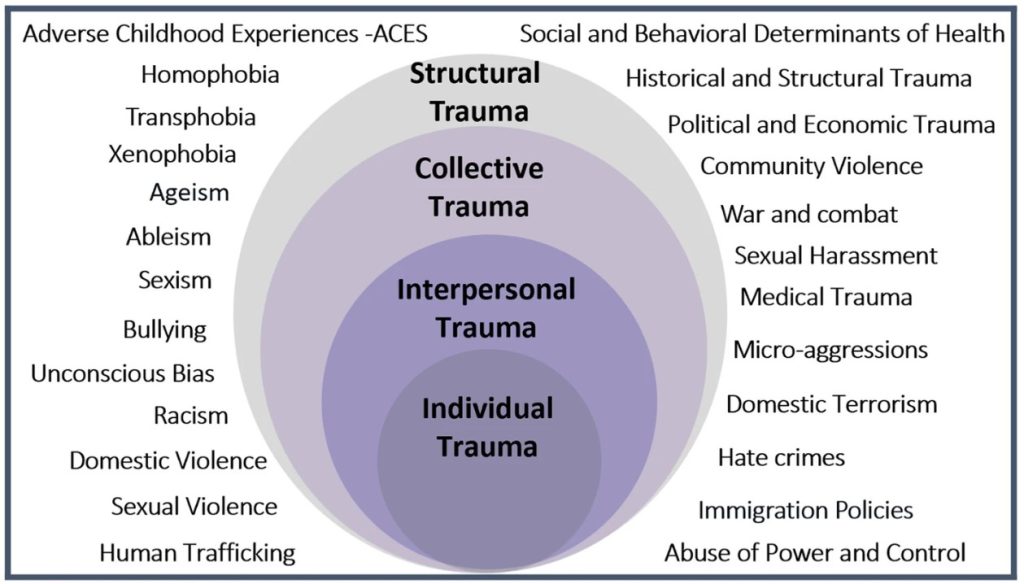
When a child grows up in a household where the parents are constantly under the temporal and systemic violence of the gig economy, the child internalizes a world-view that the world is unsafe, unpredictable, and that their value is purely transactional. This is not a “cognitive distortion” to be corrected; it is a profound, accurate survival strategy passed down through the family line. To heal this, therapy must not just examine the “family tree” but also consider the “economic forest.”
With a heavy heart, we must grieve not just what our parents did to us, but what the system did to our parents.
Case Study: The Deconstruction of Mark’s “Anger”
Let’s expand on a case study: Mark, a 34-year-old man presenting with “Anger Issues” after a violent outburst where he destroyed furniture. In a standard clinic, Mark would be given “Coping Skills” or “Cognitive Behavioral Therapy” to manage his “distorted thoughts” about his temper. But using our structural lens, we uncover a much more complex map:
- Systemic Layer: Mark works under algorithmic management as a delivery driver. His “boss” is an app that penalizes him for traffic jams he cannot control. He has no health insurance and is one car repair away from homelessness.
- Geographic Layer: He lives in a “commuter town,” a place where there are no sidewalks, no parks, and no places to meet people without spending $20 on a drink. He spends 10 hours a day in a metal box (his car).
- Symbolic Layer: He calls himself a “loser” and a “dead-end” because the Big Other (via social media and cultural narratives) tells him that at 34, he should be a “homeowner” and a “provider.” Every “lifestyle” post he sees is a symbolic blow to his self-worth.
Mark’s anger is not a behavior to be fixed. It is a symptom-protest instead. His body screams because his life is structurally unsustainable. This rage represents a frantic attempt by his nervous system to reassert agency. The world treats him like a mere data point.
Mark does not need instructions on how to breathe through his anger. He needs a different message in the therapy room. He needs to hear that his anger is the only part of him that recognizes mistreatment.
When Mark sees this, the anger changes. It stops being an embarrassing flaw. It starts being a piece of valuable data. He can finally use that information to understand his reality. This realization marks the beginning of true structural clarity.
“Why I Feel Like a Failure”: How to Help Yourself | Moving from Shame to Structural Awareness
How does someone like Mark, or us, actually help themselves once they see these structures? The pivot is moving from “Self-Improvement” to “Structural Navigation.” The first step is recognizing we hurl disapproval at ourselves. Structural awareness allows us to hurl that disapproval outward at the failing structures.
- Externalize the Critic (The “Big Other” Audit): When you feel the “Internal Critic” calling you lazy, worthless, or a failure, pause. Conduct an audit. Ask: “Who profits from me feeling this way? Does this thought come from my values, or from the market’s values?” Recognizing that the critic is a social product, not a personal truth, reduces its power. You are not “lazy”; you are perhaps “on strike” against an impossible workload.
- Validate the Body’s Refusal (Symptom-as-Signal): If you are too exhausted to “be productive,” stop viewing it as a failure of will, but rather as a strike. Your body is refusing to cooperate with a system that is over-extracting your energy. This is not weakness; it is a biological limit being reached. Respect the “No” your body is saying.
- Map the Geography of Your Pain: Look at your physical environment. If you are lonely, is it because you are “bad at people,” or is it because your neighborhood is designed to keep people apart? Acknowledge the physical barriers to your well-being. Sometimes the “cure” for depression isn’t a pill, but a community garden or a walkable street.
- Practice this idea: Traditional resilience is about being “tough” enough to take the hits. What if it’s important to consider the terrain so that we can learn how to steer through a difficult environment without believing that the difficulty is our fault?
- Seek Community: The system thrives on our isolation. The most radical thing we can do for our mental health is to find others who share our structural reality (group therapy helps because of relational connection about our similar problems). When Mark joins a driver’s union or a neighborhood group, his “anxiety” decreases because he has moved from a “competitive unit” to a “communal member.”
The “Hurl of Disapproval” as a Clinical Tool
Try the “Hurl of Disapproval” as a clinical tool. This technique helps you consciously redirect the energy of shame. Many experts define shame as anger turned inward. We must understand the structural architecture of our suffering to change this. Then, we can turn that anger back toward its true source.
This shift does not make us a victim. It validates the truth of your experience instead. Stop asking yourself what is wrong with your mind and instead consider what is wrong with a system that makes life this difficult. Move from guilt to indignation. Guilt says you did something wrong. Indignation says the system did something wrong to you. This shift provides incredible therapeutic relief. It restores the sense of a “Moral Self.” It allows you to hurl disapproval at the housing market, the healthcare system, and the “Big Other,” rather than at your own reflection. This externalization provides the psychological space needed for genuine healing to begin.
Toward a Structural Therapy: An Act of Bravery
The ultimate goal is to move therapy toward Critical Consciousness, a concept developed by educator Paulo Freire, which is to achieve a deep, structural understanding of the world allows us to see the social ‘traps’ that have been causing our pain. But awareness is one step, albeit a large one. Critical consciousness means using that insight as a map to change the identified oppressive patterns in our daily lives and taking active steps to reclaim our autonomy from the systems that benefit from our suffering.
Luceris wants to help you distinguish between your “own” pain (the inevitable griefs of being human: loss, aging, heartbreak) and the “borrowed” pain (the suffering imposed by a broken social and economic structure).
Modern clinics mostly see your “own pain.” You free up massive energy when you stop shaming your own distress. Previously, you spent that energy on self-hatred and self-optimization. Now, you can use it for community building and structural change. Use it for genuine self-compassion too.
Healing does not mean returning to a sick norm. Healing is an act of bravery. It is the process of reclaiming your narrative. Tell yourself that you are not broken. You are responding to a world that is. Stop carrying the guilt for a failure that belongs to the structure.
We must move from being “patients” to being “participants.” Join the collective struggle for a better world. We deserve a society fit for human nervous systems. Do not let the system define your worth. Your recovery starts when you look outward.
Developing critical consciousness means puncturing the ‘Symbolic Order’: the invisible grid of societal expectations, to reveal the systemic violence hidden beneath. It is the process of recognizing that your personal distress may not be a biological failure, but a political and structural symptom of the world you inhabit. Once we see the architecture of this oppression clearly, we can use that insight as a map to organize, join communities, spread awareness, and ultimately, heal ourselves. By identifying the specific traps in your daily life and taking active steps to reclaim your autonomy, you move from an isolated victim of the structure to a strategic navigator of your own life.
If you have questions about the structures we’ve explored or if you’re ready to analyze the external variables negatively impacting your mental health, please feel free to reach out. To begin the work of deconstructing these systems and reclaiming your agency, you can book an appointment with Luceris.